2026 Capital Gains Tax Changes: Smart Investment Strategies

The financial landscape is in a constant state of flux, and for investors, staying ahead of potential legislative changes is not merely advantageous but essential for preserving and growing wealth. As we look towards the horizon, the year 2026 looms large with the potential for significant shifts in the realm of capital gains taxation. Understanding these prospective changes, often referred to as the 2026 capital gains tax adjustments, is paramount for anyone engaged in investment activities. This comprehensive guide aims to demystify these upcoming modifications, providing clarity on what to expect and, more importantly, offering actionable strategies to navigate the evolving tax environment effectively.
Capital gains tax is levied on the profit realized from the sale of a non-inventory asset. These assets can include stocks, bonds, real estate, precious metals, and collectibles. The rate at which these gains are taxed depends on several factors, including the holding period of the asset (short-term vs. long-term) and the investor’s ordinary income tax bracket. The current framework has been shaped by various legislative acts, and while the specifics of the 2026 capital gains tax changes are still subject to political discourse and finalization, the general direction suggests a potential recalibration that could impact a broad spectrum of investors.
The anticipation around the 2026 capital gains tax is largely due to the scheduled expiration of certain provisions from the Tax Cuts and Jobs Act (TCJA) of 2017. Many of the individual income tax provisions, including those that indirectly affect capital gains rates for certain income brackets, are set to revert to pre-TCJA levels unless Congress acts to extend, modify, or replace them. This impending ‘tax cliff’ creates both uncertainty and opportunities for proactive planning. Ignoring these potential changes could lead to unforeseen tax liabilities, while strategic preparation can help mitigate adverse effects and even unlock new avenues for tax efficiency.
Understanding the Current Capital Gains Tax Landscape
Before delving into the potential future, it’s crucial to have a firm grasp of the current capital gains tax structure. In the United States, capital gains are categorized into two main types: short-term and long-term.
Short-Term Capital Gains
These are profits from assets held for one year or less. Short-term capital gains are taxed at an investor’s ordinary income tax rate. This means they are treated just like wages, salaries, or other forms of regular income. For high-income earners, this can result in a significant tax burden, potentially reaching the highest marginal tax bracket.
Long-Term Capital Gains
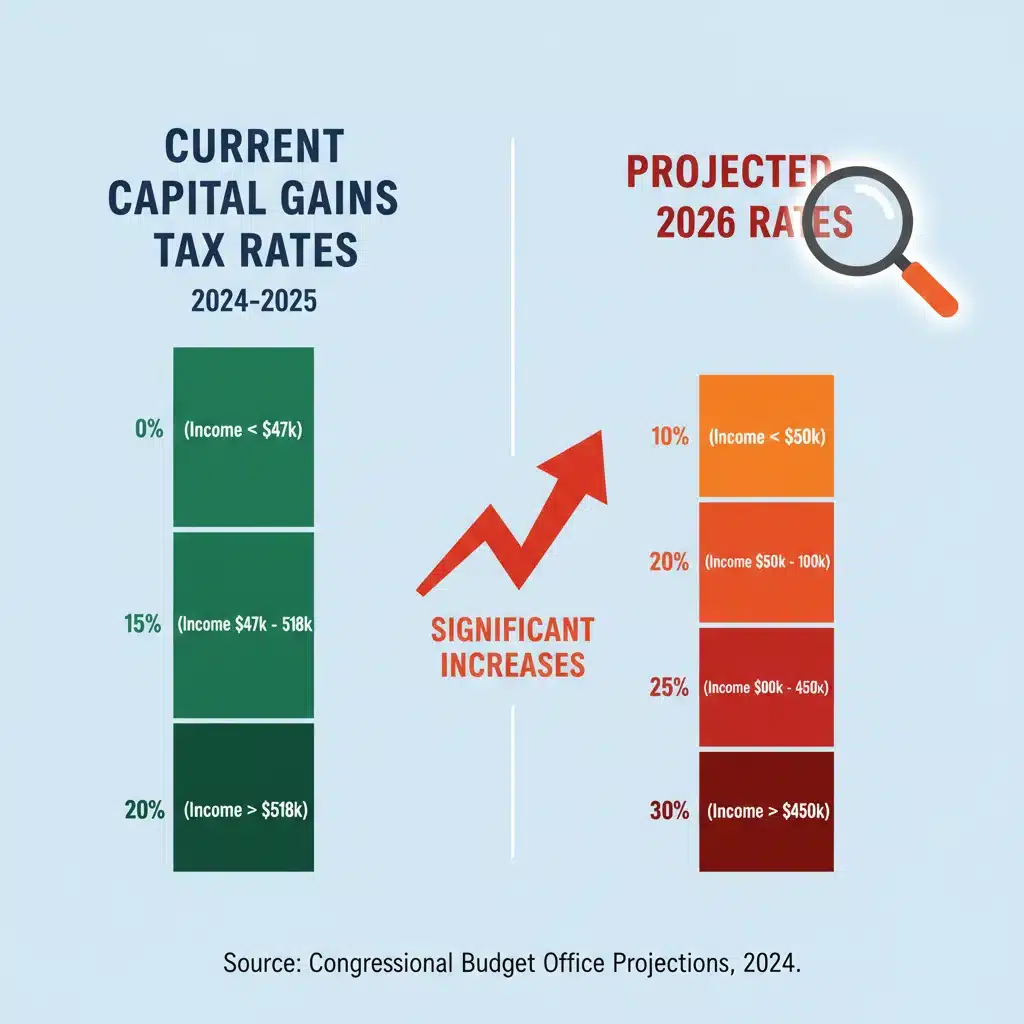
These are profits from assets held for more than one year. Long-term capital gains are subject to preferential tax rates, which are typically lower than ordinary income tax rates. Currently, there are three primary long-term capital gains tax rates: 0%, 15%, and 20%. The specific rate an individual pays depends on their taxable income. For instance, lower-income taxpayers might qualify for the 0% rate, middle-income taxpayers for the 15% rate, and high-income taxpayers for the 20% rate. This distinction between short-term and long-term gains is a cornerstone of current investment tax planning and is a critical area to monitor for any 2026 capital gains tax adjustments.
Net Investment Income Tax (NIIT)
Beyond the standard capital gains rates, some high-income taxpayers are also subject to the Net Investment Income Tax (NIIT). This is a 3.8% tax on certain net investment income, including capital gains, for individuals with modified adjusted gross income (MAGI) above specific thresholds ($200,000 for single filers, $250,000 for married filing jointly). This additional tax can significantly increase the effective rate on capital gains for affluent investors, making the potential 2026 capital gains tax changes even more impactful for this demographic.
What to Expect with the 2026 Capital Gains Tax Changes
The primary driver behind the anticipated 2026 capital gains tax changes is the expiration of key provisions from the TCJA. When these provisions sunset, the tax code is set to revert to its pre-2018 structure unless new legislation is passed. While predicting the exact legislative outcome is challenging, several scenarios are widely discussed among financial experts:
Potential for Higher Rates
One of the most significant possibilities is an increase in the long-term capital gains tax rates, particularly for higher-income individuals. Before the TCJA, the top long-term capital gains rate was often discussed in conjunction with higher ordinary income tax rates. If ordinary income tax rates rise, the effective capital gains rates for those in higher brackets could also increase, especially when factoring in the NIIT. This could mean the 20% top rate could climb, potentially affecting the overall profitability of long-term investments for a substantial portion of the investing public.
Changes to Income Thresholds
The income thresholds that determine which capital gains tax rate applies are also subject to change. If these thresholds are not adjusted for inflation or are altered by new legislation, more investors could find themselves pushed into higher capital gains tax brackets, even if their income hasn’t significantly increased in real terms. This ‘bracket creep’ could effectively raise the tax burden for many without an explicit rate hike.
Impact on Estate Planning
While not a direct capital gains tax, the estate tax and its associated step-up in basis provisions are often linked to broader tax reform discussions. The TCJA significantly increased the estate tax exemption amount. If this exemption reverts to lower pre-TCJA levels, it could have profound implications for wealth transfer and the taxation of inherited assets, indirectly influencing how appreciated assets are treated upon the death of an owner. This is an important consideration for long-term investors planning for the 2026 capital gains tax environment.
Uncertainty and Legislative Action
It’s crucial to remember that the 2026 capital gains tax changes are not set in stone. Congress could act to extend the current provisions, enact new legislation that modifies them, or allow them to expire as scheduled. The political climate and the economic conditions leading up to 2026 will play a significant role in shaping the final outcome. Investors should stay informed about legislative developments and consult with financial professionals to understand the most up-to-date information.
Strategies for Smart Investment Planning in Anticipation of 2026
Given the potential for changes, proactive planning is essential. Here are several strategies investors can consider to optimize their portfolios and minimize potential tax liabilities in the face of the 2026 capital gains tax adjustments:
1. Tax-Loss Harvesting
This strategy involves selling investments at a loss to offset capital gains and, potentially, a limited amount of ordinary income. If you have realized significant capital gains, harvesting losses can help reduce your overall tax bill. This strategy is particularly effective in volatile markets. By strategically selling losing assets, you can create a tax shield against realized gains. Any net capital loss can also be used to offset up to $3,000 of ordinary income per year, with any remaining loss carried forward indefinitely to future tax years. This technique becomes even more valuable if capital gains rates are projected to increase, as offsetting gains in a lower-rate environment now could be more beneficial than waiting.
2. Review Your Asset Allocation and Location
Consider where your assets are held. Tax-advantaged accounts like 401(k)s, IRAs, and Roth IRAs offer significant tax benefits. Growth-oriented investments that generate substantial capital gains might be better suited for these accounts, as gains are tax-deferred or tax-free upon withdrawal (in the case of Roth accounts). Conversely, investments that generate ordinary income (like bonds or REITs) might be more suitable for tax-deferred accounts. Rebalancing your portfolio to align with these tax-efficient strategies can be a powerful tool against the potential impact of the 2026 capital gains tax.
3. Consider Qualified Opportunity Funds (QOFs)
QOFs allow investors to defer and potentially reduce capital gains taxes by reinvesting those gains into designated low-income communities. If held for a sufficient period, the original deferred gain can be reduced, and any new gains from the QOF investment can become tax-free. This is a complex strategy, but for those with significant capital gains, it could offer substantial tax advantages, especially as we approach the 2026 capital gains tax changes.
4. Utilize Charitable Giving Strategies
Donating appreciated assets (like stocks or real estate) directly to a qualified charity can be a highly tax-efficient strategy. If you donate appreciated assets that you’ve held for more than a year, you can typically deduct the fair market value of the asset and avoid paying capital gains tax on the appreciation. This is often more beneficial than selling the asset, paying the capital gains tax, and then donating the cash. Strategies like Donor-Advised Funds (DAFs) can further enhance this approach, allowing for a current tax deduction while granting you the flexibility to recommend grants to charities over time. This approach could be particularly attractive if higher capital gains rates are enacted in 2026.
5. Re-evaluate Your Holding Periods
With potential changes to long-term capital gains rates, the distinction between short-term and long-term gains becomes even more critical. Investors should carefully consider the holding period of their assets. If you’re on the cusp of the one-year mark for a highly appreciated asset, waiting a few extra days or weeks to qualify for long-term capital gains treatment could result in significant tax savings, especially if the spread between ordinary income rates and long-term capital gains rates widens under the 2026 capital gains tax regime.
6. Consult with Financial and Tax Professionals
The most crucial strategy is to engage with experienced financial advisors and tax professionals. They can provide personalized advice based on your unique financial situation, risk tolerance, and investment goals. These experts stay abreast of the latest legislative developments and can help you develop a robust strategy tailored to the evolving 2026 capital gains tax environment. Their insights can help you optimize your portfolio, navigate complex tax laws, and ensure compliance while maximizing your after-tax returns.
Long-Term Investment Outlook and the 2026 Capital Gains Tax
Beyond immediate strategies, it’s important to consider the long-term implications of the 2026 capital gains tax changes on your overall investment philosophy. While tax considerations are important, they should not be the sole driver of investment decisions. A well-diversified portfolio aligned with your financial goals remains paramount.
Focus on Quality Investments
Regardless of tax rates, investing in high-quality assets with strong fundamentals and long-term growth potential is always a sound strategy. Companies with sustainable competitive advantages, solid balance sheets, and consistent earnings growth tend to perform well over time, irrespective of short-term tax fluctuations. The goal is to generate significant pre-tax returns, even if a portion of those returns is subject to higher taxation.
Embrace Diversification
Diversification across different asset classes, industries, and geographies helps mitigate risk and can provide more consistent returns. A diversified portfolio is less susceptible to adverse changes in any single sector or to specific tax law adjustments that might disproportionately affect one type of asset. This foundational principle of investing remains critical when planning for the 2026 capital gains tax.
Regular Portfolio Reviews
The impending tax changes serve as an excellent reminder to conduct regular, thorough reviews of your investment portfolio. This includes assessing your risk tolerance, re-evaluating your financial goals, and ensuring your asset allocation remains appropriate. These reviews also provide an opportunity to implement tax-efficient strategies and make any necessary adjustments in anticipation of the 2026 capital gains tax.
The Broader Economic and Political Context
The eventual shape of the 2026 capital gains tax will not occur in a vacuum. It will be influenced by the broader economic climate, including inflation, interest rates, and the health of the job market. Political considerations will also play a significant role. The composition of Congress and the White House in the years leading up to 2026 will heavily influence whether current tax provisions are extended, modified, or allowed to expire.
Economic conditions can impact investment returns and, consequently, the amount of capital gains realized. For example, periods of high inflation might lead to higher nominal gains, but the real (inflation-adjusted) gains might be less impressive. Conversely, a robust economy could lead to strong market performance, generating substantial capital gains that would then be subject to the new tax regime. Understanding these interconnected factors is crucial for holistic financial planning.
Furthermore, the debate around tax policy often involves discussions about economic fairness, revenue generation for government programs, and incentives for investment and economic growth. These broader policy objectives will shape the legislative proposals related to the 2026 capital gains tax, making it a dynamic area to monitor for any investor.

Conclusion: Proactive Planning for the 2026 Capital Gains Tax
The anticipated 2026 capital gains tax changes represent a significant juncture for investors. While the precise details are yet to be finalized, the prudent approach is to prepare for various scenarios by understanding the potential impacts and implementing proactive strategies. From tax-loss harvesting and optimizing asset location to exploring charitable giving and consulting with financial experts, there are numerous avenues to navigate the evolving tax landscape effectively.
The key takeaway is that waiting until the last minute is a risky proposition. By staying informed, reviewing your investment portfolio regularly, and seeking professional guidance, you can position yourself to not only mitigate potential tax burdens but also to capitalize on new opportunities that may arise. The year 2026 is not just a date on the calendar; it’s a call to action for informed and strategic investment planning. Embrace the challenge, adapt your strategies, and secure your financial future against the backdrop of changing tax laws.
Remember, the goal is not just to minimize taxes but to maximize after-tax returns and achieve your long-term financial objectives. A well-thought-out plan, executed with discipline and expert advice, will be your most valuable asset in the face of the 2026 capital gains tax and beyond. Start your planning today to ensure a smooth transition and continued success in your investment journey.
Author