2026 Unemployment Benefits: State Comparison & Maximizing Support

In an ever-evolving economic landscape, understanding your potential safety nets is paramount. For many, the prospect of job loss can be daunting, but unemployment benefits serve as a critical lifeline, offering temporary financial assistance while individuals seek new employment. As we look ahead to 2026, it’s crucial to comprehend the nuances of state-specific unemployment insurance programs. These programs are not uniform; they vary significantly in terms of eligibility, weekly benefit amounts, and the duration for which benefits can be received. This comprehensive guide will delve into the intricacies of 2026 unemployment benefits, providing a detailed comparison of state programs and offering insights into how to maximize your support for up to 26 weeks.
The year 2026, while still some time away, will continue to see states managing their unemployment insurance funds and adjusting policies based on economic forecasts, legislative changes, and past unemployment rates. Therefore, staying informed about these evolving regulations is key to ensuring you’re prepared should the need arise. Our aim is to demystify the process, highlight key differences between state offerings, and empower you with the knowledge to navigate the system effectively.
Understanding the Foundation of Unemployment Benefits
Before we dive into state-by-state comparisons for 2026 unemployment benefits, it’s essential to grasp the fundamental principles of how these programs operate. Unemployment insurance (UI) is a joint state and federal program that provides temporary financial payments to eligible workers who are unemployed through no fault of their own. The funding for UI benefits comes from taxes paid by employers, not from employee wages.
Eligibility Criteria: A Universal Starting Point with State Variations
While specific requirements can differ, most states share core eligibility criteria. To qualify for 2026 unemployment benefits, you generally must meet the following:
- Monetary Eligibility: You must have earned a certain amount of wages during a specified period (known as the ‘base period’) before becoming unemployed. The base period typically looks at your earnings over the first four of the last five completed calendar quarters prior to filing your claim. Each state sets its own minimum earnings threshold.
- Reason for Separation: You must be unemployed through no fault of your own. This usually means you were laid off, your position was eliminated, or you were furloughed. If you quit your job voluntarily without good cause (as defined by state law) or were fired for misconduct, you may be disqualified from receiving benefits.
- Ability and Availability to Work: You must be physically and mentally able to work and actively seeking new employment. States often require claimants to register with their state’s workforce agency and engage in specific job search activities, such as applying for a certain number of jobs per week.
- Weekly Certification: To continue receiving benefits, you must typically certify weekly or bi-weekly that you are still unemployed, actively looking for work, and meet all other eligibility requirements.
These foundational elements form the bedrock of unemployment benefits across the nation. However, the exact thresholds, definitions of ‘good cause’ for quitting, and specific job search requirements are where states begin to diverge significantly, impacting who qualifies for 2026 unemployment benefits and under what circumstances.
Comparing State Unemployment Programs for 2026: Key Metrics
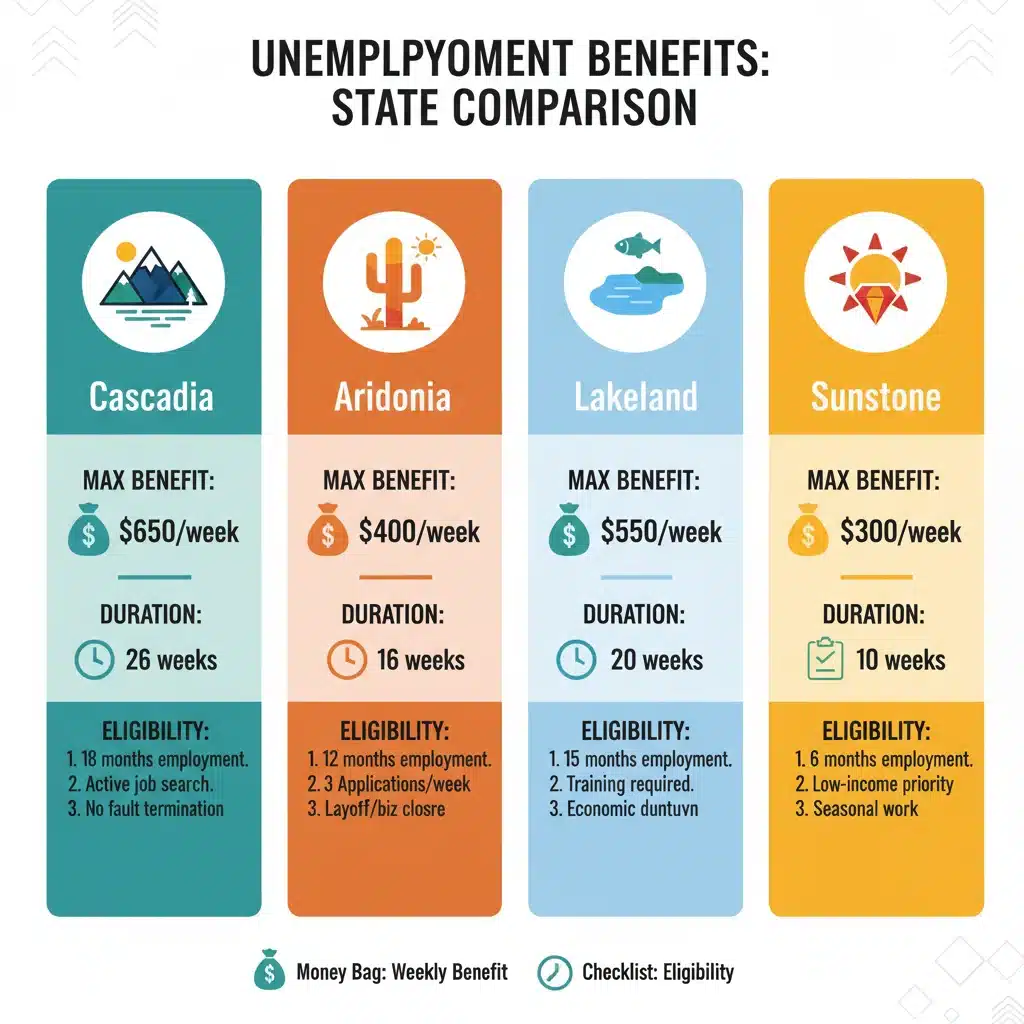
When evaluating which state programs offer the best support for 2026 unemployment benefits, several key metrics come into play. These include the maximum weekly benefit amount, the maximum duration of benefits, and specific qualifying conditions that can make a substantial difference for claimants.
Maximum Weekly Benefit Amount (WBA)
The WBA is perhaps the most immediate concern for individuals facing job loss. This is the highest amount of money an eligible individual can receive per week. States calculate this based on a percentage of your past earnings during the base period, up to a statutory maximum. The disparity here can be significant. For instance, some states might offer a maximum weekly benefit of around $300-$400, while others, often those with higher costs of living, might exceed $800-$900 per week. This variance directly impacts the financial stability of unemployed individuals.
For 2026 unemployment benefits, it’s reasonable to expect these maximums to be adjusted in some states, reflecting inflation or changes in average wages. However, the relative ranking of states in terms of generosity is likely to remain consistent. High-wage states often correlate with higher maximum WBAs.
Maximum Duration of Benefits: Up to 26 Weeks and Beyond
The standard duration for which most states provide unemployment benefits is 26 weeks. This 26-week period is a federal guideline, but states have the flexibility to offer shorter or, in rare cases, longer durations based on their own laws and economic conditions. During periods of high unemployment, federal extended benefits programs can kick in, potentially extending benefits beyond the standard 26 weeks, but these are contingent on specific economic triggers at both state and national levels.
For 2026 unemployment benefits, the 26-week benchmark will likely remain the common maximum. However, it’s vital to check state-specific rules. Some states have implemented triggers that reduce benefit duration when unemployment rates are very low, while others might maintain the 26 weeks regardless. Understanding your state’s specific duration policy is crucial for long-term financial planning.
Qualifying Conditions and Disqualifications
Beyond the basic eligibility, states also have varying rules regarding qualifying conditions and potential disqualifications. These can include:
- Quitting for Good Cause: What constitutes ‘good cause’ for voluntarily leaving a job varies. It might include unsafe working conditions, employer harassment, or a significant change in working conditions. Some states are more lenient than others.
- Misconduct: The definition of ‘misconduct’ leading to termination also differs. Gross misconduct (e.g., theft) almost universally disqualifies, but minor infractions or a pattern of poor performance might be treated differently depending on the state.
- Availability for Work: While all states require claimants to be available for work, the specifics can vary. Some states might allow for part-time work while receiving reduced benefits, while others might have stricter interpretations.
- Dependency Allowances: A few states offer additional allowances for dependents, which can increase the total weekly benefit amount. This is a significant additional benefit for families.
These subtle differences in state regulations for 2026 unemployment benefits can have a profound impact on an individual’s ability to claim and receive support.
Key States to Watch for 2026 Unemployment Benefits
While a definitive ranking for 2026 is speculative, we can analyze historical trends and current state policies to identify states that typically offer more robust unemployment benefits. It’s important to remember that ‘best’ can be subjective, depending on whether you prioritize high weekly payments, longer duration, or more flexible eligibility rules.
States with Historically Higher Maximum Weekly Benefits
States like Massachusetts, New Jersey, Washington, and Minnesota have historically offered some of the highest maximum weekly benefit amounts. These states often have higher average wages, and their UI systems are designed to replace a larger percentage of those wages, up to their statutory maximums. Individuals who earned high salaries in these states could find their 2026 unemployment benefits significantly more substantial than in other parts of the country.
For example, a state like Massachusetts might offer a maximum WBA exceeding $900, while a state in the South might cap out around $350-$400. This disparity is a critical factor for individuals relocating or considering employment in different states.
States with Consistent 26-Week Durations
Most states adhere to the 26-week maximum duration. However, some states have implemented ‘flexible’ duration models where the maximum number of weeks can decrease during periods of low unemployment. States that consistently maintain the 26-week maximum, regardless of immediate economic indicators (barring federal program changes), offer greater predictability. Examples often include states with more stable economies or those that prioritize consistent safety nets.
States with Potentially More Lenient Eligibility or Additional Allowances
A few states stand out for offering specific provisions that can be beneficial. For instance, some states offer dependent allowances, significantly boosting the weekly benefit for claimants with children. Others might have slightly broader definitions of ‘good cause’ for voluntary separation, or more flexible job search requirements.
When considering 2026 unemployment benefits, it’s not just about the raw numbers but also the overall accessibility and comprehensiveness of the program. Researching your specific state’s Department of Labor or Workforce Development website will provide the most accurate and up-to-date information as 2026 approaches.
Maximizing Your 2026 Unemployment Benefits
Navigating the unemployment system can be complex, but strategic planning and diligent action can help you maximize your 2026 unemployment benefits. Here’s how:
1. Understand Your State’s Specific Rules
This cannot be stressed enough. Every state has its unique handbook and regulations. Before you even think about filing, familiarize yourself with your state’s Department of Labor website. Pay close attention to:
- Base Period Calculation: How your wages are used to determine your WBA.
- Weekly Certification Questions: What information you’ll need to provide regularly.
- Job Search Requirements: The minimum number of job contacts or activities required each week.
- Reporting Requirements: How to report any earnings from part-time work or other income.
2. Maintain Meticulous Records
Documentation is your best friend when dealing with government agencies. Keep detailed records of:
- Employment History: Start and end dates, employers’ contact information, reasons for separation.
- Wages and Pay Stubs: Proof of earnings during your base period.
- Job Search Activities: Dates, company names, contact persons, positions applied for, and outcomes.
- Communications with the UI Office: Dates, times, names of representatives, and summaries of conversations.
3. File Your Claim Promptly
As soon as you become unemployed, file your claim. Benefits are typically not retroactive to your last day of work but rather to the week you file your initial claim. Delays can mean lost weeks of benefits. Many states now allow for online filing, which is often the quickest method.

4. Be Honest and Accurate
Provide truthful and complete information on all application forms and weekly certifications. Misrepresenting facts can lead to disqualification, penalties, and even criminal charges. If you’re unsure about how to answer a question, seek clarification from your state’s unemployment office.
5. Actively Engage in Job Search
This is a core requirement. Don’t view it as a mere formality. The quicker you find new employment, the better for your long-term financial health. Utilize all resources available through your state’s workforce development agencies, including job boards, resume assistance, and workshops. Document every job application and interview meticulously, as you may be asked to provide this information.
6. Understand Appeals Processes
If your claim for 2026 unemployment benefits is denied, don’t despair. You have the right to appeal the decision. Understand the appeal deadlines and procedures in your state. Often, an initial denial can be overturned on appeal, especially if there was a misunderstanding or incomplete information in the initial filing.
7. Report Any Changes in Circumstances
If you start working part-time, receive severance pay, or have any other change that might affect your eligibility, report it immediately to the unemployment office. Failure to do so can result in overpayments that you will be required to repay, sometimes with penalties.
The Economic Outlook and 2026 Unemployment Benefits
The landscape of 2026 unemployment benefits will inevitably be shaped by the broader economic climate. Factors such as inflation, interest rates, labor market trends, and global events can all influence state budgets and, consequently, their unemployment insurance programs. While the standard 26-week duration is common, a severe economic downturn could trigger federal extended benefits, as seen during past recessions. Conversely, a robust economy might lead some states to consider adjustments to their UI trust funds or eligibility criteria.
Staying abreast of economic news and legislative proposals at both federal and state levels is a proactive step. While individual states largely govern their UI programs, federal legislation can significantly impact funding, duration, and even eligibility standards, particularly during national emergencies or economic crises. Therefore, for those planning for or potentially facing unemployment in 2026, a holistic view of both state-specific policies and broader economic indicators is essential.
Conclusion: Preparing for 2026 Unemployment Benefits
The world of 2026 unemployment benefits is characterized by a blend of federal guidelines and significant state-level variations. While the overarching goal of providing temporary financial relief remains constant, the specifics of how that relief is delivered—from weekly amounts and duration to eligibility nuances—differ considerably across the United States. States like Massachusetts, New Jersey, Washington, and Minnesota often lead in terms of maximum weekly benefits, while most states adhere to the 26-week duration, with some exceptions based on economic triggers.
For individuals seeking to understand or potentially utilize these benefits, the key lies in proactive research, meticulous record-keeping, and prompt action. Familiarizing yourself with your specific state’s Department of Labor regulations is paramount. By understanding the eligibility criteria, knowing how benefits are calculated, and adhering to all reporting and job search requirements, you can maximize your chances of receiving the support you are entitled to for up to 26 weeks, or potentially longer if federal extensions become active.
As 2026 approaches, continuous vigilance regarding economic shifts and legislative updates will be crucial. Unemployment benefits are a vital safety net, and being well-informed is the best way to ensure that this safety net is there for you when you need it most. Prepare now to navigate the system with confidence and secure your financial well-being during periods of job transition.
Author