Mastering 401(k) Contributions 2026: Limits, Strategies, and Growth

Retirement planning is a journey that requires foresight, discipline, and a keen understanding of the financial landscape. As we look ahead to 2026, understanding the nuances of 401(k) contributions becomes paramount for anyone serious about securing their financial future. The 401(k) is a cornerstone of many individuals’ retirement strategies, offering significant tax advantages and the potential for substantial growth over time. However, to truly harness its power, one must stay informed about the latest contribution limits, strategic approaches, and best practices.
The year 2026 promises new adjustments and considerations that could impact your retirement savings. This comprehensive guide is designed to equip you with the knowledge and tools necessary to optimize your 401(k) contributions, ensuring you are on the path to a robust and comfortable retirement. We will delve into the projected 2026 401(k) contribution limits, explore advanced strategies for maximizing your savings, and discuss how to align your 401(k) with your broader financial goals. Whether you are a seasoned investor or just starting your retirement planning journey, mastering your 401(k) contributions for 2026 is a critical step towards financial independence.
Understanding the 2026 401(k) Contribution Limits
One of the most anticipated pieces of information for retirement savers each year is the updated 401(k) contribution limits. While the official numbers for 2026 are typically released in late 2025 by the IRS, we can make informed projections based on historical trends and economic indicators. These limits are adjusted annually for inflation, reflecting changes in the cost of living and aiming to maintain the purchasing power of retirement savings.
Projected Standard Contribution Limits for 2026
For 2026, it is highly probable that the standard employee contribution limit for 401(k) plans will see an increase. In recent years, these limits have steadily risen, allowing individuals to save more for retirement on a tax-advantaged basis. Based on current inflation rates and economic forecasts, a reasonable projection for the standard 401(k) contributions 2026 limit could be in the range of $24,000 to $25,000. This is a significant amount that, if fully utilized, can dramatically boost your retirement nest egg.
It’s crucial to remember that this limit applies to your pre-tax or Roth 401(k) contributions, or a combination of both. Employer contributions, such as matching contributions or profit-sharing, are separate and do not count towards this individual limit. However, there is an overall limit for total contributions to a 401(k) plan, which includes both employee and employer contributions. We will discuss this comprehensive limit shortly.
Catch-Up Contributions for Those 50 and Over
For individuals aged 50 and older, the IRS provides an invaluable opportunity to supercharge their retirement savings through catch-up contributions. These additional contributions allow older workers to contribute more than the standard limit, recognizing that they may have less time to save before retirement or may be playing catch-up for periods when they couldn’t contribute as much. The catch-up contribution limit for 401(k) plans has also seen increases over time.
For 2026, the catch-up contribution limit is also expected to rise, potentially reaching $8,000 or even $8,500. This means that if you are 50 or older, you could potentially contribute a combined total of $32,000 to $33,500 to your 401(k) in 2026 (standard limit plus catch-up). This extra saving power is a critical tool for those nearing retirement, offering a last chance to significantly boost their retirement funds. It is essential to take advantage of these higher 401(k) contributions 2026 limits if you qualify.
Total Contribution Limits (Employee + Employer)
Beyond the individual employee contribution limit, there’s an overarching limit on the total amount that can be contributed to your 401(k) plan each year, combining both your contributions and your employer’s contributions (including matching funds, profit-sharing, and any other employer contributions). This limit is also adjusted annually for inflation. For 2026, this total contribution limit is projected to be in the range of $69,000 to $70,500.
Understanding this total limit is important, especially if your employer offers generous matching or profit-sharing contributions. While most individuals won’t hit this combined limit solely through their own contributions, it’s a good benchmark to be aware of. If your employer’s contributions are substantial, it could impact how much you can personally contribute, particularly if you’re a highly compensated employee. Always consult with your plan administrator to understand how your employer’s contributions fit into the overall limit.
Strategic Approaches to Maximize Your 401(k) Contributions in 2026
Simply knowing the 401(k) contributions 2026 limits is only half the battle. The other half involves implementing smart strategies to ensure you are maximizing your contributions and, by extension, your retirement savings. Here are several key strategies to consider:
1. Contribute at Least Enough to Get the Full Employer Match
This is often referred to as "free money" and is arguably the most important strategy. Many employers offer a matching contribution, where they contribute a certain percentage of your salary to your 401(k) if you contribute a specified amount. For example, an employer might match 50% of your contributions up to 6% of your salary. If you contribute less than 6%, you’re leaving free money on the table.
Make it a priority to contribute at least enough to receive the maximum employer match. This immediately boosts your savings and provides an instant, guaranteed return on your investment, far surpassing what you’d typically find elsewhere. This should be the absolute minimum goal for your 401(k) contributions 2026.
2. Automate Your Contributions and Increase Them Annually
The easiest way to ensure consistent saving is to automate your 401(k) contributions. Set up payroll deductions so that a portion of each paycheck goes directly into your retirement account before you even see it. This "pay yourself first" approach prevents you from spending money that should be saved.
Furthermore, commit to increasing your contribution percentage annually. Many financial advisors recommend increasing your contribution by 1% each year, especially when you receive a raise. This incremental increase is often barely noticeable in your take-home pay but can have a profound impact on your retirement savings over decades. This strategy ensures your 401(k) contributions 2026 continue to grow over time.
3. Understand the Power of Compounding
Compounding is the engine of long-term wealth creation. It’s the process where your investments earn returns, and then those returns themselves earn returns. The earlier you start contributing and the more consistently you contribute, the more time compounding has to work its magic.
Even small increases in your 401(k) contributions 2026 can lead to significantly larger sums in retirement due to compounding. For example, an extra $100 per month contributed consistently over 30 years, earning an average annual return of 7%, could add tens of thousands of dollars to your retirement fund. Visualizing this long-term growth can be a powerful motivator to maximize your contributions.
4. Consider a Roth 401(k) vs. Traditional 401(k)
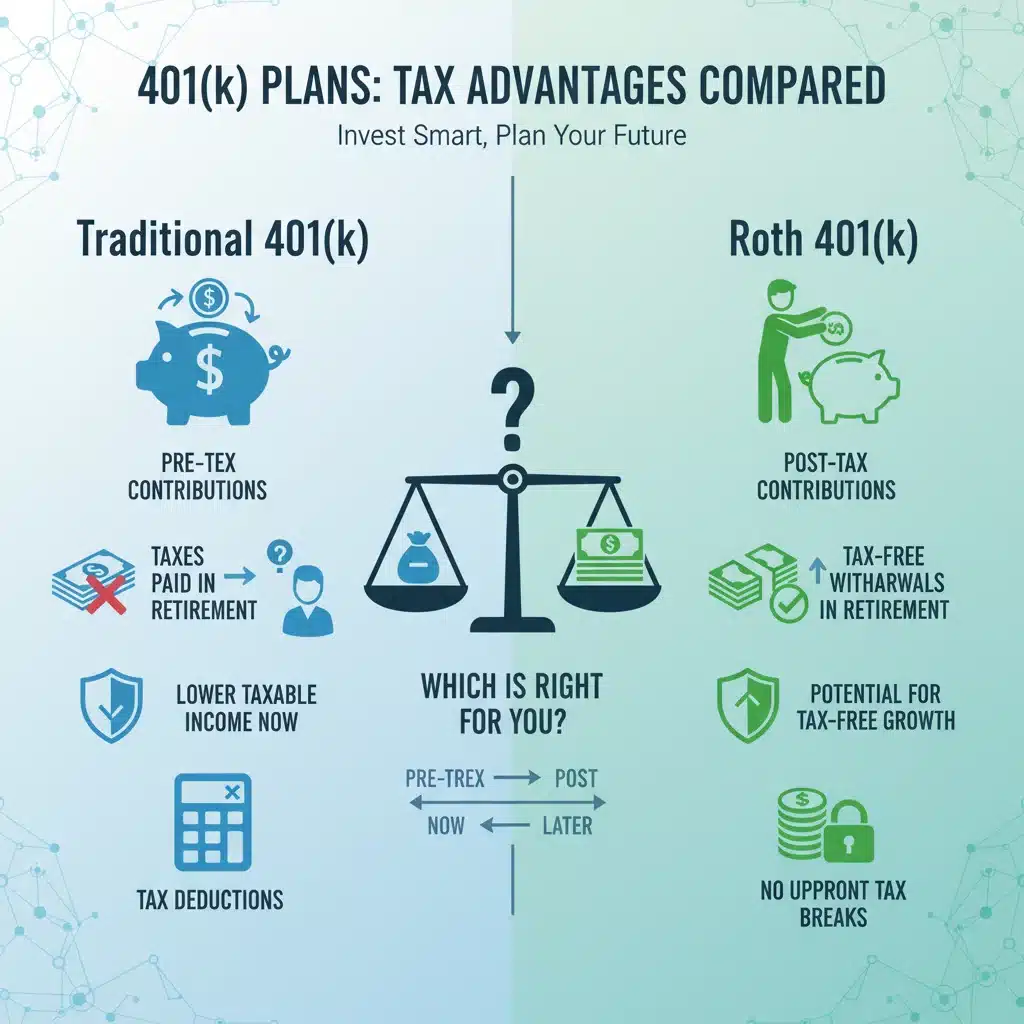
Many employers offer both a Traditional 401(k) and a Roth 401(k). Understanding the differences and choosing the right option for your situation is crucial. The primary distinction lies in when you pay taxes:
- Traditional 401(k): Contributions are made pre-tax, reducing your current taxable income. Your money grows tax-deferred, and you pay taxes on your withdrawals in retirement. This is generally beneficial if you expect to be in a lower tax bracket in retirement than you are now.
- Roth 401(k): Contributions are made with after-tax dollars, meaning they do not reduce your current taxable income. However, your qualified withdrawals in retirement are completely tax-free. This is often advantageous if you expect to be in a higher tax bracket in retirement or if you want tax-free income in your golden years.
For 2026, analyze your current income, projected future income, and tax bracket expectations to determine which option (or a combination of both) makes the most sense for you. Some individuals choose to split their contributions between Traditional and Roth to hedge against future tax rate uncertainty.
5. Don’t Forget Catch-Up Contributions (If Applicable)
As mentioned earlier, if you are 50 or older by the end of 2026, do not overlook the opportunity to make catch-up contributions. These additional contributions are a powerful way to accelerate your savings, especially if you started saving later in life or had periods where you couldn’t contribute as much. Prioritize these extra contributions to make up for lost time and maximize your 401(k) contributions 2026.
Beyond Contributions: Investment Strategies within Your 401(k)
While maximizing your 401(k) contributions 2026 is vital, how you invest those contributions within your plan is equally important. A well-diversified and appropriately allocated portfolio can significantly impact your long-term growth.
Diversification and Asset Allocation
Diversification is the practice of spreading your investments across various asset classes (e.g., stocks, bonds, real estate) to reduce risk. Asset allocation refers to the specific mix of these asset classes in your portfolio, typically based on your age, risk tolerance, and time horizon.
- Stocks (Equities): Offer higher growth potential but come with greater volatility.
- Bonds (Fixed Income): Generally less volatile than stocks, providing income and stability.
- Target-Date Funds: A popular choice, these funds automatically adjust their asset allocation over time, becoming more conservative as you approach your target retirement date. They offer a hands-off approach to diversification.
Review your 401(k) investment options and ensure your portfolio is diversified according to your risk profile. As you get closer to retirement, you might gradually shift towards a more conservative allocation to protect your accumulated wealth.
Fees Matter: Understand Your Plan’s Costs
Fees, even seemingly small ones, can erode a significant portion of your returns over decades. Be aware of the fees associated with your 401(k) plan and the investment options within it. These can include administrative fees, record-keeping fees, and expense ratios for mutual funds or ETFs.
Compare the expense ratios of similar funds within your plan. Opting for lower-cost index funds or ETFs when available can save you thousands of dollars over your investment horizon, directly contributing to higher net returns. Your plan administrator should provide detailed information about all associated fees. Understanding these costs is an integral part of optimizing your 401(k) contributions 2026.
Rebalancing Your Portfolio
Over time, market fluctuations can cause your portfolio’s asset allocation to drift from your target. Rebalancing involves adjusting your portfolio back to its original desired asset mix. For example, if stocks have performed exceptionally well, they might now represent a larger percentage of your portfolio than you intended. Rebalancing would involve selling some stocks and buying more bonds to restore your desired allocation.
This practice helps manage risk and ensures your portfolio remains aligned with your long-term financial goals. Most experts recommend rebalancing annually or semi-annually. This can be particularly important for maintaining the effectiveness of your 401(k) contributions 2026.
Integrating Your 401(k) with Your Overall Financial Plan
Your 401(k) is a powerful tool, but it’s just one piece of your broader financial puzzle. For optimal retirement planning, it’s essential to integrate your 401(k) strategy with your other financial goals and accounts.
Emergency Fund First
Before aggressively maximizing your 401(k) contributions 2026, ensure you have a robust emergency fund. This fund, typically 3-6 months of living expenses held in an easily accessible, liquid account (like a high-yield savings account), acts as a financial safety net. It prevents you from needing to withdraw from your 401(k) prematurely, which can incur penalties and taxes, undermining your retirement goals.
Debt Management
High-interest debt, such as credit card debt, can be a significant drag on your financial progress. While contributing to your 401(k) to get the employer match is usually a priority, aggressively paying down high-interest debt can often provide a "guaranteed return" equal to the interest rate you avoid. Balance your 401(k) contributions 2026 with a strategic approach to debt repayment.
Other Retirement Accounts: IRAs and HSAs
Depending on your income and financial situation, you might also consider contributing to other tax-advantaged retirement accounts:
- Individual Retirement Accounts (IRAs): Both Traditional and Roth IRAs offer additional avenues for retirement savings. They have their own contribution limits and income restrictions. An IRA can complement your 401(k), especially if your employer’s 401(k) plan has limited investment options or high fees.
- Health Savings Accounts (HSAs): If you have a high-deductible health plan, an HSA can be a triple tax-advantageous account: tax-deductible contributions, tax-free growth, and tax-free withdrawals for qualified medical expenses. Many consider HSAs to be a "super 401(k)" for healthcare costs in retirement.
Exploring these additional options can further enhance your retirement security alongside your 401(k) contributions 2026.
Estate Planning Considerations
As your retirement nest egg grows, it’s wise to consider how your 401(k) fits into your overall estate plan. Ensure your beneficiary designations are up-to-date. These designations supersede your will for your 401(k) assets, so it’s critical they reflect your current wishes. Regularly review and update your beneficiaries, especially after major life events like marriage, divorce, or the birth of a child.
Common Pitfalls to Avoid with Your 401(k)
Even with the best intentions, some individuals make mistakes that can hinder their 401(k) growth. Being aware of these common pitfalls can help you avoid them:
1. Not Contributing Enough (or Anything at All)
The biggest mistake is not contributing to your 401(k) at all, or not contributing enough to get the full employer match. This is leaving free money and significant tax advantages on the table. Start early, even if it’s a small amount, and gradually increase your 401(k) contributions 2026 over time.
2. Taking Loans or Early Withdrawals
While some 401(k) plans allow for loans or hardship withdrawals, these should be considered absolute last resorts. Loans must be repaid with interest (which you pay to yourself, but it’s still money not invested), and early withdrawals before age 59½ are typically subject to ordinary income tax plus a 10% penalty. These actions severely hamper the power of compounding and can derail your retirement plans.
3. Being Too Conservative or Too Aggressive with Investments
Finding the right balance in your investment allocation is key. Being too conservative, especially early in your career, means you might miss out on significant growth potential. Conversely, being too aggressive as you approach retirement can expose your accumulated savings to undue market risk. Regularly review and adjust your asset allocation to align with your risk tolerance and time horizon.
4. Ignoring Your 401(k) After Setup
Once you set up your contributions and choose your initial investments, it’s easy to forget about your 401(k). However, regular review is essential. Market conditions change, your financial goals evolve, and new investment options may become available. Make it a habit to review your 401(k) at least once a year to ensure your contributions and investments are still aligned with your objectives for 2026 and beyond.

The Importance of Professional Guidance
Navigating the complexities of 401(k) contributions 2026, investment options, and tax implications can be challenging. For many, seeking professional financial advice can be invaluable. A qualified financial advisor can help you:
- Assess your current financial situation and retirement goals.
- Determine the optimal contribution strategy for your specific circumstances, including how much to contribute to your 401(k) and other retirement accounts.
- Develop a personalized investment strategy tailored to your risk tolerance and time horizon.
- Understand the tax implications of your choices and help you maximize tax efficiency.
- Provide ongoing guidance and adjustments to your plan as your life circumstances change.
While this article provides a solid foundation for understanding 401(k) contributions 2026, a financial advisor can offer tailored advice that considers your unique financial picture. Their expertise can help you make informed decisions and avoid costly mistakes, ultimately leading to a more secure and prosperous retirement.
Conclusion: Your Path to a Secure Retirement with Optimized 401(k) Contributions 2026
Optimizing your 401(k) contributions for 2026 is a critical component of a robust retirement plan. By staying informed about the projected limits, strategically maximizing your contributions, and making wise investment choices, you can significantly enhance your financial security in retirement. Remember to prioritize employer matching, automate your savings, understand the power of compounding, and regularly review your investment strategy.
The journey to a comfortable retirement is a marathon, not a sprint. Consistent effort, informed decisions, and a long-term perspective are your greatest allies. By taking proactive steps now to master your 401(k) contributions 2026, you are building a stronger foundation for your future, ensuring that your golden years are truly golden. Start planning today, stay disciplined, and watch your retirement dreams become a reality.
Author