Student Loan Repayment: New Federal Programs and 2025 Deadlines

Navigating the complex world of federal student loan repayment requires understanding new programs and critical 2025 deadlines to optimize financial strategies and avoid potential pitfalls.
For millions of Americans, student loan debt represents a significant financial burden. However, the landscape of federal student loan repayment is continuously evolving, offering new programs and critical deadlines that can profoundly impact borrowers’ financial futures. Understanding these changes, particularly concerning the student loan repayment 2025 deadlines and new federal initiatives, is not just beneficial but essential for effective financial management.
Understanding the SAVE Plan: A Game Changer
The Saving on a Valuable Education (SAVE) Plan, launched in the summer of 2023, represents the most significant overhaul of income-driven repayment (IDR) plans in over a decade. Designed to make student loan payments more affordable and prevent interest accrual, the SAVE Plan is a lifeline for many borrowers struggling with high monthly costs. It replaces the Revised Pay As You Earn (REPAYE) Plan and brings substantial benefits that can drastically reduce financial pressure.
Borrowers should familiarize themselves with the SAVE Plan’s specific provisions, as they offer tangible relief. The plan calculates monthly payments based on a lower percentage of discretionary income compared to previous IDR plans, and it includes an interest subsidy that prevents unpaid interest from accumulating, a common source of frustration and increased debt for many.
Key Benefits of the SAVE Plan
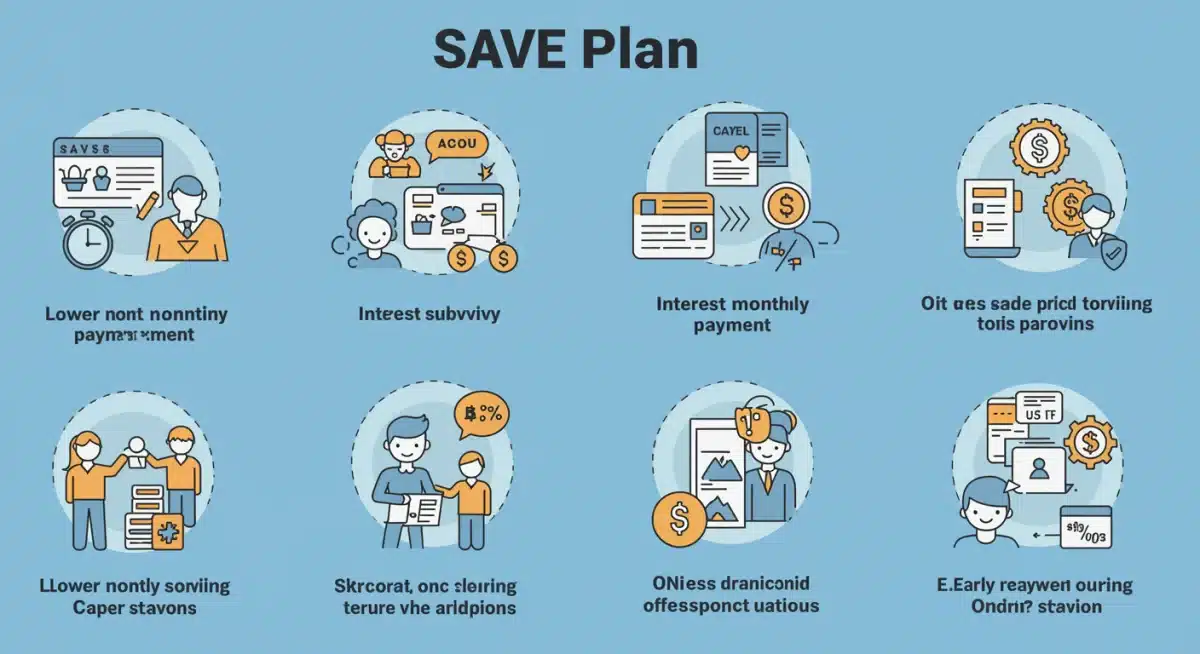
- Lower Monthly Payments: Payments are calculated based on 10% of discretionary income for undergraduate loans, and 5% for graduate loans (or a weighted average for mixed loans). Starting July 1, 2024, this will drop to 5% for undergraduate loans.
- Interest Subsidy: If your calculated payment doesn’t cover the monthly interest, the government covers the remaining interest, preventing your balance from growing due to unpaid interest.
- Faster Forgiveness: Borrowers with original loan balances of $12,000 or less may see forgiveness after just 10 years of payments. This is a significant reduction from the standard 20 or 25 years.
The SAVE Plan is not merely a temporary fix; it’s a long-term solution aimed at making higher education debt more manageable. Its design encourages borrowers to stay in repayment, knowing that their balance won’t balloon due to compounding interest. This stability is crucial for financial planning and allows borrowers to focus on other financial goals, such as saving for a home or retirement. Understanding how to enroll and re-certify annually is vital to maximize its advantages.
Critical 2025 Deadlines for Loan Forgiveness and Enrollment
As we look towards 2025, several crucial deadlines are approaching that borrowers need to be aware of, especially concerning loan forgiveness programs and enrollment in new repayment plans. Missing these deadlines could mean missing out on significant financial relief or opportunities to lower monthly payments. Proactive planning and staying informed are key to navigating these timelines successfully.
One of the most important aspects involves the Public Service Loan Forgiveness (PSLF) program and potential adjustments related to the IDR Account Adjustment. While the IDR Account Adjustment has already provided significant relief, its effects and any remaining opportunities will certainly extend into 2025. Borrowers who believe they might qualify for PSLF but haven’t yet taken action should review their eligibility and submit necessary documentation well in advance.
Key Deadlines to Monitor
- IDR Account Adjustment Finalization: While many adjustments have been processed, the full impact and any remaining opportunities for credit towards forgiveness under the IDR Account Adjustment are expected to solidify and potentially close by mid-2025. This adjustment critically reviews past payments, including periods of forbearance and deferment, to grant additional credit toward IDR and PSLF forgiveness.
- SAVE Plan Annual Recertification: Borrowers enrolled in the SAVE Plan will need to recertify their income and family size annually to maintain their eligibility and payment level. While the exact date will vary for each borrower based on their enrollment, many will find their recertification falling within 2025.
- PSLF Application Window: For those seeking PSLF, ensuring all employment certification forms are up-to-date and submitted correctly is paramount. While PSLF is an ongoing program, any specific waivers or temporary expansions might have associated deadlines that could expire in 2025.
Beyond these federal programs, some state-specific or employer-sponsored student loan assistance programs may also have application windows or eligibility requirements that fall within 2025. It is advisable for borrowers to regularly check official government resources, such as the Federal Student Aid website, and consult with their loan servicers for personalized updates and guidance. Staying organized with documents and correspondence is crucial for successful navigation.
Eligibility Requirements for New Federal Programs
Accessing the benefits of new federal student loan programs, such as the SAVE Plan and various forgiveness initiatives, hinges on meeting specific eligibility criteria. These requirements are put in place to ensure that the relief reaches those who need it most and to maintain the integrity of the programs. Understanding these prerequisites is the first step toward determining which options are available to you and what actions you need to take.
Generally, federal student loans are eligible for income-driven repayment plans like SAVE. However, certain loan types, such as Federal Family Education Loan (FFEL) Program loans or Perkins Loans, might need to be consolidated into a Direct Consolidation Loan to qualify. This consolidation process itself has its own set of considerations and timelines, which borrowers must factor into their planning.
Who Qualifies for the SAVE Plan?
- Loan Type: Most federal student loans, including Direct Subsidized Loans, Direct Unsubsidized Loans, Direct PLUS Loans, and Direct Consolidation Loans, are eligible. FFEL and Perkins Loans require consolidation.
- Income: Eligibility and payment amounts are based on your discretionary income, which is your adjusted gross income (AGI) minus 225% of the federal poverty guideline for your family size and state of residence.
- Application: You must apply or switch to the SAVE Plan through StudentAid.gov and provide updated income and family size information annually.
For loan forgiveness programs like PSLF, the requirements are even more stringent, involving employment with a qualifying government or non-profit organization and making a specific number of qualifying payments. It’s not enough to simply be employed in public service; the employer must meet the federal definition of a qualifying employer, and the payments must be made under a qualifying repayment plan. Verifying these details early can prevent disappointment later on.
Consolidation and Its Role in Accessing Benefits
For many borrowers, particularly those with older federal student loans, Direct Loan Consolidation is a critical step to unlock access to the newest repayment plans and forgiveness opportunities. This process combines multiple federal student loans into a single new loan with a single interest rate, making it simpler to manage and often a prerequisite for certain benefits.
The strategic importance of consolidation cannot be overstated, especially for borrowers with FFEL Program loans, Perkins Loans, or Health Education Assistance Loan (HEAL) Program loans. Without consolidation into a Direct Consolidation Loan, these loan types are typically not eligible for the SAVE Plan or the full benefits of the IDR Account Adjustment. The process itself is straightforward but requires careful attention to detail.
Benefits of Direct Loan Consolidation
- Access to New IDR Plans: Consolidating older federal loans makes them eligible for the SAVE Plan and other income-driven repayment options.
- Simplified Repayment: One loan, one monthly payment, and one loan servicer can significantly simplify financial management.
- Potential for Forgiveness Credit: For borrowers who consolidate by a certain deadline (which could extend into 2025 for some), the IDR Account Adjustment can credit past payments towards forgiveness, even for periods of forbearance or deferment.
It is crucial to understand that while consolidation can be highly beneficial, it does reset the clock on the number of payments made toward IDR or PSLF forgiveness for the new consolidated loan. However, the IDR Account Adjustment is designed to mitigate this by providing a one-time review of past payments, giving borrowers credit for periods that previously didn’t count. Borrowers considering consolidation should consult with their loan servicer or a trusted financial advisor to ensure they understand all implications and deadlines, especially those related to the IDR Account Adjustment, which has a significant impact on forgiveness timelines.
Navigating Loan Servicers and Communication
Effective communication with your student loan servicer is paramount for successfully navigating federal student loan repayment, especially with new programs and deadlines on the horizon. Loan servicers are your primary point of contact for managing your loans, making payments, and applying for repayment plans or forgiveness programs. However, the quality of service can vary, and knowing how to interact effectively is key.
Many borrowers experience frustration with servicers due to long wait times, inconsistent information, or complex processes. To mitigate these issues, it is essential to maintain meticulous records of all communications, including dates, times, names of representatives, and summaries of conversations. Always follow up phone calls with written confirmation via email or letter if possible, especially for critical actions or requests.
Tips for Effective Servicer Communication
- Keep Detailed Records: Document every interaction, including dates, names, and what was discussed.
- Use Official Channels: Submit applications and documents through your servicer’s official portal or mail with tracking.
- Be Persistent: If you don’t get a clear answer or feel something is incorrect, don’t hesitate to follow up or escalate your concern.
- Verify Information: Cross-reference information provided by your servicer with official sources like StudentAid.gov.
Furthermore, regularly checking your loan servicer’s online portal for important announcements, changes to your account, or required actions is a good practice. Many servicers send email notifications, but these can sometimes be missed or filtered. Being proactive in checking your account status and understanding any communication received can prevent missed deadlines or unexpected issues. If you encounter persistent problems or believe your servicer is not handling your account correctly, you have the right to file a complaint with the Federal Student Aid Ombudsman Group or the Consumer Financial Protection Bureau.
Strategies for Optimizing Your Repayment Plan by 2025
With new federal programs and critical deadlines in 2025, borrowers have a unique opportunity to optimize their student loan repayment strategies. This involves more than just making timely payments; it requires a comprehensive review of your financial situation, understanding available options, and making informed decisions to minimize costs and maximize potential forgiveness.
The first step in optimizing your repayment plan is to assess your current financial standing. This includes evaluating your income, expenses, and overall debt load. Knowing these figures will help you determine which repayment plan, particularly an income-driven one like SAVE, best fits your budget and long-term financial goals. Don’t assume your current plan is the best; always explore alternatives.
Key Optimization Strategies
- Review Your Loan Types: Determine if you have older federal loans (FFEL, Perkins) that could benefit from consolidation to access new IDR plans and the IDR Account Adjustment.
- Evaluate IDR Plans: Compare the SAVE Plan with other IDR options (PAYE, IBR, ICR) to see which offers the lowest monthly payment and fastest path to forgiveness for your specific situation. Use the Loan Simulator on StudentAid.gov.
- Explore Forgiveness: If you work in public service, ensure you are on track for PSLF by certifying your employment annually and making qualifying payments. Also, check if you qualify for any other targeted forgiveness programs.
- Annual Recertification: Make sure to recertify your income and family size for your IDR plan promptly each year to avoid payment increases or being placed on a standard plan.
Beyond federal programs, consider your broader financial goals. If you have high-interest debt elsewhere, creating a holistic debt management plan might be beneficial. For some, making extra payments on their student loans, if affordable, can reduce the total interest paid and shorten the repayment period, especially if they are not pursuing forgiveness. However, for those aiming for forgiveness, consistently making the lowest possible payment under an IDR plan might be the most strategic approach. The key is to be proactive, informed, and adaptable as policies continue to evolve.
The Future of Student Loan Repayment Beyond 2025
While 2025 presents immediate challenges and opportunities, it is also important to consider the longer-term outlook for student loan repayment. The federal government has shown a sustained commitment to reforming student aid and repayment, suggesting that further changes and new initiatives could emerge in the years to come. Staying adaptable and informed will be crucial for borrowers as the landscape continues to evolve.
Discussions around student loan debt relief and reforms are ongoing, with various proposals being considered at different levels of government. These could include further expansions of loan forgiveness programs, adjustments to IDR plan parameters, or even new approaches to financing higher education. While nothing is certain, the trend points towards continued efforts to make student debt more manageable for the average American.
Potential Future Developments
- Further IDR Enhancements: Expect potential tweaks or additional benefits to existing IDR plans, including the SAVE Plan, as the government collects more data on their effectiveness.
- Targeted Forgiveness: New or expanded forgiveness programs for specific professions or circumstances may be introduced, building on the success of programs like PSLF.
- Simplification Efforts: Calls for simplifying the overall student loan system, from application to repayment, could lead to more streamlined processes and clearer communication.
Borrowers should cultivate a habit of regularly checking official government sources like StudentAid.gov and reputable financial news outlets for updates. Engaging with financial literacy resources and potentially consulting with non-profit credit counselors can also provide valuable insights and personalized advice. The goal is to remain agile, ready to adapt your repayment strategy to take advantage of any new beneficial policies or programs that may arise, ensuring your financial well-being in the long run.
| Key Program/Deadline | Brief Description |
|---|---|
| SAVE Plan | New income-driven repayment plan offering lower payments and interest subsidy. |
| IDR Account Adjustment | One-time review of past payments for credit towards IDR/PSLF forgiveness, with impacts extending into 2025. |
| PSLF Program | Forgiveness for public service workers after 120 qualifying payments, ongoing with potential 2025-specific deadlines. |
| Loan Consolidation | Combining federal loans to access new benefits, crucial for older loan types by 2025. |
Frequently Asked Questions About Student Loan Repayment 2025
The SAVE Plan significantly lowers monthly payments by calculating them based on a smaller percentage of discretionary income. Crucially, it prevents loan balances from growing due to unpaid interest, as the government covers any interest not met by your reduced payment.
Not all loans require consolidation. Direct Loans are automatically eligible. However, older federal loans like FFEL Program loans or Perkins Loans usually need to be consolidated into a Direct Consolidation Loan to become eligible for the SAVE Plan and other modern benefits.
The IDR Account Adjustment is a one-time initiative to correct past payment counts for IDR and PSLF forgiveness, by crediting periods of forbearance and deferment. While many adjustments have occurred, its full effects and any remaining deadlines are expected to finalize by mid-2025, making it a critical window for borrowers.
To ensure your PSLF payments are counting, you must be employed full-time by a qualifying government or non-profit organization, be enrolled in a qualifying repayment plan (like an IDR plan), and submit an Employer Certification Form annually or whenever you change jobs. Regularly check your payment count with your servicer.
If you encounter issues with your loan servicer, document all communications. Attempt to resolve it directly with the servicer. If unsuccessful, you can file a complaint with the Federal Student Aid Ombudsman Group or the Consumer Financial Protection Bureau for assistance and intervention.
Conclusion
Navigating the intricate landscape of federal student loan repayment, especially with the introduction of new programs like the SAVE Plan and the critical 2025 deadlines, demands vigilance and proactive engagement from borrowers. Understanding the eligibility requirements, the strategic role of loan consolidation, and the importance of effective communication with loan servicers are all components of a successful repayment strategy. By staying informed about these changes and utilizing available resources, borrowers can significantly reduce their financial burden, optimize their repayment paths, and move closer to financial freedom, ensuring they are well-prepared for the evolving future of student loan policies.
Author