
Student Loan Forgiveness 2026: Your Complete Eligibility & Application Guide
The landscape of student loan debt in the United States is constantly evolving, with millions of Americans seeking relief from the burden of educational borrowing. As we look towards 2026, understanding the available avenues for student loan forgiveness 2026 is more critical than ever. Whether you’re a recent graduate, a seasoned professional in public service, or someone who has been navigating repayment for years, changes in federal policies and program requirements can significantly impact your financial future. This comprehensive guide aims to demystify the various student loan forgiveness 2026 programs, outlining eligibility criteria, application processes, and crucial tips to help you successfully navigate your path to debt relief.
Student loan debt has become a significant economic concern, affecting individuals’ ability to save for retirement, purchase homes, and achieve other financial milestones. With the federal government and various organizations offering programs designed to alleviate this burden, staying informed is paramount. This article will serve as your go-to resource for understanding what student loan forgiveness 2026 entails, ensuring you have the knowledge to pursue the relief you may be entitled to.
Understanding the Current State of Student Loan Forgiveness
Before diving into the specifics of student loan forgiveness 2026, it’s essential to grasp the current environment. The past few years have seen significant discussions, proposals, and adjustments to federal student loan programs. While broad, one-time forgiveness initiatives have faced legal challenges, several established programs continue to offer substantial relief. These programs are typically tied to specific career paths, repayment behaviors, or extenuating circumstances. The key is to understand which programs align with your unique situation.
The Biden administration has focused on strengthening existing programs and implementing targeted relief measures. This includes adjustments to Income-Driven Repayment (IDR) plans and Public Service Loan Forgiveness (PSLF), as well as specific relief for borrowers defrauded by their institutions or those with permanent disabilities. As we approach 2026, these existing frameworks will likely remain the primary avenues for forgiveness, though new legislative efforts could always emerge. Therefore, staying updated on official announcements from the U.S. Department of Education and Federal Student Aid (FSA) is crucial.
The complexity often lies in the details of eligibility and the often-lengthy application processes. Many borrowers miss out on potential forgiveness simply because they are unaware of the programs or find the application daunting. Our goal here is to simplify this information, providing clear, actionable steps for anyone seeking student loan forgiveness 2026.
Key Student Loan Forgiveness Programs for 2026
Several established federal programs are expected to continue offering student loan forgiveness 2026. Each has distinct requirements and benefits. Let’s explore the most prominent ones:
1. Public Service Loan Forgiveness (PSLF)
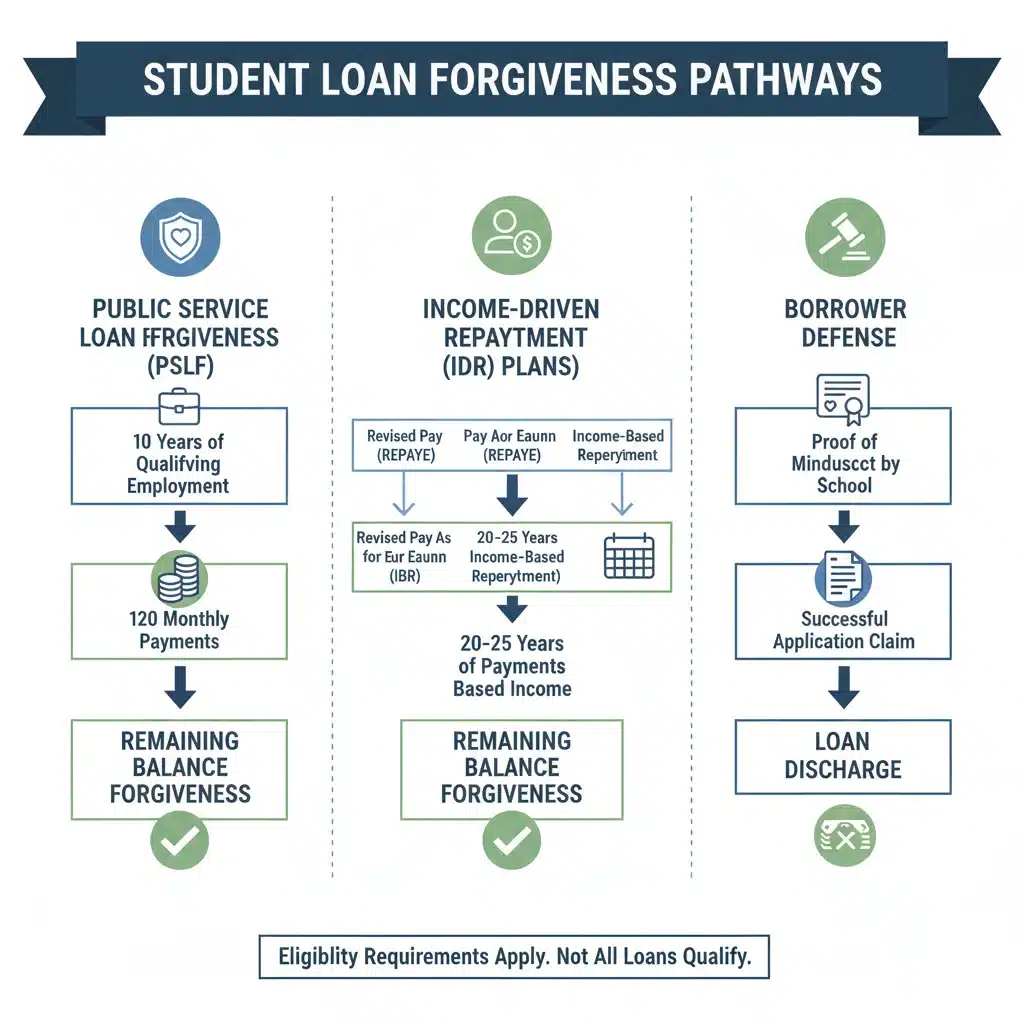
PSLF remains one of the most significant pathways to debt relief for individuals working in public service. If you are employed by a U.S. federal, state, local, or tribal government organization, or a qualifying non-profit organization, you might be eligible. The core requirement is to make 120 qualifying monthly payments while working full-time for a qualifying employer and having Direct Loans. After these payments, your remaining balance is forgiven and is not considered taxable income by the IRS.
PSLF Eligibility for 2026:
- Qualifying Employment: Work for a government organization (federal, state, local, or tribal) or a 501(c)(3) non-profit. Some other non-profits may qualify if they provide specific public services.
- Loan Type: Only Direct Loans are eligible. If you have FFEL or Perkins Loans, you must consolidate them into a Direct Consolidation Loan.
- Payment Requirements: 120 qualifying monthly payments (10 years’ worth). Payments must be made on time, for the full amount due, and under a qualifying repayment plan (typically an Income-Driven Repayment plan).
- Full-Time Employment: Generally, this means working at least 30 hours per week for one qualifying employer or multiple qualifying employers.
Applying for PSLF in 2026:
The process involves submitting an Employer Certification Form (ECF) annually or whenever you change employers. This form verifies your employment and helps track your qualifying payments. Once you believe you’ve made 120 qualifying payments, you’ll submit a PSLF application. It’s highly recommended to submit ECFs regularly to ensure your payments are being counted correctly and to address any issues early.
2. Income-Driven Repayment (IDR) Plan Forgiveness
IDR plans are designed to make loan payments affordable by capping them at a percentage of your discretionary income. While their primary purpose is to manage monthly payments, a significant benefit is that any remaining loan balance is forgiven after 20 or 25 years of payments, depending on the specific plan. The Biden administration has made efforts to fix historical inaccuracies in IDR payment counts, which may bring many borrowers closer to forgiveness.
IDR Plan Types and Forgiveness Timelines:
- SAVE Plan (Saving on a Valuable Education): The newest IDR plan, offering lower monthly payments and potential for forgiveness in as little as 10 years for low-balance borrowers. Forgiveness typically occurs after 20 or 25 years for undergraduate or graduate loans, respectively.
- Pay As You Earn (PAYE): Forgiveness after 20 years of qualifying payments.
- Income-Based Repayment (IBR): Forgiveness after 20 or 25 years, depending on when you took out your loans.
- Income-Contingent Repayment (ICR): Forgiveness after 25 years.
Eligibility and Application for IDR Forgiveness in 2026:
You must enroll in an IDR plan and make consistent payments. The key is to recertify your income and family size annually. Failing to do so can lead to capitalized interest and a loss of progress towards forgiveness. While the forgiveness is automatic once you meet the payment threshold, accurately tracking your payments and ensuring you’re on the correct plan is vital. The IDR Account Adjustment is a significant initiative that may retroactively count more months towards forgiveness for many borrowers, so understanding its impact on your loans is crucial.
3. Teacher Loan Forgiveness (TLF)
This program is specifically for teachers who work in low-income schools or educational service agencies. Eligible teachers can receive up to $17,500 in forgiveness for Direct Subsidized and Unsubsidized Loans and Federal Stafford Loans.
TLF Eligibility for 2026:
- Qualifying Employment: Teach full-time for five complete and consecutive academic years in a low-income school or educational service agency.
- Subject Area: The amount of forgiveness depends on the subject taught. Highly qualified math and science teachers at the secondary level, and special education teachers at the elementary or secondary level, can receive up to $17,500. Other qualified teachers can receive up to $5,000.
- Loan Status: Loans must have been made before the end of your five academic years of qualifying teaching service.
Applying for TLF in 2026:
After completing your five years of service, you’ll need to complete the Teacher Loan Forgiveness Application and submit it to your loan servicer. Your chief administrative officer at the school or agency must certify your eligibility.
4. Borrower Defense to Repayment
This program offers loan forgiveness if your school misled you or engaged in other misconduct in violation of certain state laws. This could include misrepresenting job placement rates, program accreditation, or career services. Recent changes have streamlined the process for many borrowers, especially those who attended specific institutions that have been found to engage in widespread misconduct.
Eligibility for Borrower Defense in 2026:
- You must prove that your school engaged in misconduct that directly relates to your federal student loans or the educational services for which the loans were provided.
- Evidence can include official documents, testimonies, or other verifiable proof of misrepresentation or fraud.
Applying for Borrower Defense in 2026:
You can apply online through the Federal Student Aid website. You’ll need to provide details about your school, program, and the specific misconduct you experienced, along with any supporting documentation. The process can take time, but successful claims can result in full loan discharge.
5. Total and Permanent Disability (TPD) Discharge
If you have a total and permanent disability, you may be eligible to have your federal student loans discharged. This relief is available if you cannot engage in any substantial gainful activity due to a physical or mental impairment that can be expected to result in death, has lasted for a continuous period of at least 60 months, or can be expected to last for a continuous period of at least 60 months.
Eligibility for TPD Discharge in 2026:
- You must provide documentation from the U.S. Department of Veterans Affairs (VA), the Social Security Administration (SSA), or a physician certifying your total and permanent disability.
Applying for TPD Discharge in 2026:
Applications are managed by Nelnet, the servicer for TPD discharges. You can apply online or by mail. Once approved, you’ll enter a three-year monitoring period to ensure you continue to meet the eligibility requirements, particularly regarding your income.
6. Closed School Discharge
If your school closes while you’re enrolled or shortly after you withdraw, you might be eligible for a closed school discharge. This relieves you from repaying the federal student loans you took out to attend that school.
Eligibility for Closed School Discharge in 2026:
- Your school must have closed while you were enrolled or within 180 days of your withdrawal.
- You must not have completed your program or transferred your credits to another school within a certain timeframe.
Applying for Closed School Discharge in 2026:
Your loan servicer or the Department of Education might automatically discharge your loans if they have information about your school’s closure. However, it’s best to contact your loan servicer directly to confirm eligibility and apply if necessary.
General Eligibility Criteria for Student Loan Forgiveness 2026
While each program has specific requirements, some general criteria apply across most federal student loan forgiveness 2026 initiatives:
- Federal Loans Only: Most federal forgiveness programs apply exclusively to federal student loans (Direct Loans, FFEL Program loans, Perkins Loans). Private student loans are generally not eligible for federal forgiveness programs.
- Loan Status: Your loans typically need to be in good standing or not in default. If you are in default, you may need to resolve that status first (e.g., through loan rehabilitation) before becoming eligible for forgiveness programs.
- Application Process: Forgiveness is rarely automatic (except for some TPD and closed school discharges). You must actively apply and often provide documentation to support your claim.
- Tax Implications: While PSLF is tax-free, forgiveness under IDR plans can sometimes be considered taxable income by the IRS, though this has been temporarily waived for certain periods. It’s crucial to consult a tax professional regarding your specific situation.
Step-by-Step Guide to Applying for Student Loan Forgiveness in 2026
Navigating the application process for student loan forgiveness 2026 can seem complex, but breaking it down into manageable steps can help. Here’s a general roadmap:
Step 1: Identify Your Loan Types
The first and most crucial step is to know what kind of student loans you have. Log in to StudentAid.gov using your FSA ID. This portal provides a comprehensive overview of all your federal student loans, including their types (Direct, FFEL, Perkins), servicers, and current status. This information will dictate which forgiveness programs you might be eligible for.
Step 2: Research Eligible Forgiveness Programs
Based on your loan types, employment history, and personal circumstances, research the programs detailed above (PSLF, IDR, TLF, Borrower Defense, TPD, Closed School). Pay close attention to the specific eligibility requirements for each. Don’t assume you don’t qualify without thoroughly reviewing the criteria.
Step 3: Consolidate Loans if Necessary
If you have FFEL Program loans or Perkins Loans, and you wish to pursue PSLF or certain IDR plans, you will likely need to consolidate them into a Direct Consolidation Loan. This process can take several weeks, so plan accordingly. Be aware that consolidation resets your payment count for IDR and PSLF, though recent adjustments might allow past payments to count towards forgiveness.
Step 4: Understand and Enroll in a Qualifying Repayment Plan
For PSLF and IDR forgiveness, being on the correct repayment plan is critical. Most borrowers pursuing these paths will need to be on an Income-Driven Repayment (IDR) plan. Use the Loan Simulator tool on StudentAid.gov to compare plans and find the one that best fits your financial situation and forgiveness goals.
Step 5: Gather Required Documentation
Each application requires specific documentation. This might include:
- Employment verification forms (for PSLF and TLF).
- Income and family size documentation (for IDR plans).
- Medical documentation (for TPD discharge).
- Evidence of school misconduct (for Borrower Defense).
- Loan statements and payment history.
Keep meticulous records of all communications with your loan servicer and the Department of Education.
Step 6: Complete and Submit Applications
Fill out the necessary application forms accurately and completely. Most applications can be submitted online through StudentAid.gov or directly to your loan servicer. Double-check all information before submitting.
Step 7: Follow Up and Monitor Progress
After submitting an application, don’t just wait. Follow up with your loan servicer to confirm receipt and inquire about the processing timeline. For PSLF, regularly submit Employer Certification Forms. For IDR, remember to recertify your income and family size annually. Keep copies of everything you submit and any correspondence you receive.

Important Considerations and Tips for 2026
- Stay Informed: Federal student loan policies can change. Regularly check official sources like StudentAid.gov for the latest updates and announcements regarding student loan forgiveness 2026.
- Beware of Scams: Never pay for student loan forgiveness services. The application for all federal programs is free. Be wary of companies promising instant forgiveness or asking for your FSA ID password.
- Contact Your Loan Servicer: Your loan servicer is your primary point of contact for questions about your specific loans and repayment options. They can guide you through the application process for various programs.
- Keep Records: Maintain a detailed file of all your loan documents, payment confirmations, employment verification, and correspondence. This can be invaluable if disputes arise.
- Understand Tax Implications: While some forgiveness is tax-free, other types may be considered taxable income. Consult with a tax professional to understand the potential impact on your federal and state taxes.
- The IDR Account Adjustment: This one-time adjustment aims to correct past administrative errors and ensure borrowers receive proper credit towards IDR and PSLF forgiveness. Many borrowers will see their payment counts increase. Make sure your loans are eligible (e.g., consolidate FFEL loans into Direct Loans by the deadline if you haven’t already).
The Future of Student Loan Forgiveness Beyond 2026
While our focus is on student loan forgiveness 2026, it’s worth noting that the conversation around student debt relief is ongoing. Future legislative actions could introduce new programs or modify existing ones. Economic conditions, political priorities, and advocacy efforts all play a role in shaping federal student aid policies. For now, the most reliable path to forgiveness lies in understanding and diligently pursuing the established programs. By staying proactive and informed, you can best position yourself to benefit from any current or future opportunities for student loan relief.
Conclusion
Navigating the world of student loan forgiveness 2026 requires diligence, understanding, and proactive engagement. While the process can seem overwhelming, significant relief is available for those who qualify and take the necessary steps. By identifying your loan types, understanding the various programs like PSLF, IDR, TLF, Borrower Defense, TPD, and Closed School Discharge, and meticulously following the application procedures, you can significantly reduce or eliminate your student loan debt.
Remember to utilize official resources like StudentAid.gov, communicate regularly with your loan servicer, and keep thorough records. The journey to financial freedom from student debt is a marathon, not a sprint, but with the right information and persistent effort, achieving student loan forgiveness 2026 is an attainable goal. Don’t let the complexity deter you; take control of your financial future today.