Federal Funding for Special Education 2026: A Comprehensive Guide for US Educators

Federal Funding for Special Education 2026: A Comprehensive Guide for US Educators
As we approach 2026, the landscape of education funding, particularly for special education, continues to evolve. For US educators, staying informed about these changes is not just beneficial; it’s essential for ensuring that students with disabilities receive the support and resources they need to thrive. The federal government plays a pivotal role in supplementing state and local efforts to fund special education services, primarily through landmark legislation such as the Individuals with Disabilities Education Act (IDEA). Understanding the nuances of Special Education Funding 2026 will empower school administrators, teachers, and support staff to strategically plan, allocate resources, and advocate effectively for their students.
This comprehensive guide will delve into the anticipated shifts, key policies, and practical implications of federal funding for special education in 2026. We will explore the historical context, current challenges, and future outlook, providing actionable insights for navigating this critical area of educational finance. Our aim is to equip you with the knowledge necessary to optimize funding utilization and enhance outcomes for students with special needs.
The Foundation: Understanding IDEA and Its Funding Mandates
At the heart of Special Education Funding 2026 is the Individuals with Disabilities Education Act (IDEA). Enacted in 1975 (originally as the Education for All Handicapped Children Act), IDEA ensures that all children with disabilities have access to a free appropriate public education (FAPE) that emphasizes special education and related services designed to meet their unique needs and prepare them for further education, employment, and independent living. IDEA comprises four parts: Part A (General Provisions), Part B (Assistance for Education of All Children with Disabilities), Part C (Infants and Toddlers with Disabilities), and Part D (National Activities to Improve Education of Children with Disabilities).
Part B is particularly relevant to K-12 educators, as it outlines the requirements for states and local educational agencies (LEAs) to provide special education and related services to eligible children aged 3-21. While IDEA mandates these services, it originally promised to fund 40% of the average per-pupil cost of special education. However, federal appropriations have historically fallen short of this commitment, typically hovering around 15-18%. This significant funding gap often places a considerable burden on state and local budgets, making efficient resource management and proactive advocacy even more crucial.
As we look towards 2026, discussions around increasing federal contributions to IDEA funding continue. Educators must monitor legislative developments closely, as any significant increase in federal appropriation could dramatically alter resource availability at the local level. Conversely, stagnant or declining federal support would necessitate even more innovative and collaborative approaches to funding special education services. Understanding these foundational elements is the first step in preparing for Special Education Funding 2026.
Key Policy Alerts and Potential Changes for 2026
The year 2026 may bring several policy alerts and shifts that will directly impact Special Education Funding 2026. Congress regularly reviews and reauthorizes major education acts, and while a full reauthorization of IDEA by 2026 might be ambitious, incremental changes or new legislative initiatives are always possible. Educators should pay close attention to the following areas:
- IDEA Reauthorization Discussions: Even without a full reauthorization, preliminary discussions and proposed amendments to IDEA could begin to surface. These might target specific aspects of service delivery, eligibility criteria, or, most importantly, funding formulas. Advocacy groups and professional organizations will likely be active in these discussions, and their positions can offer early indicators of potential policy directions.
- Annual Appropriations Bills: The most immediate and tangible impact on federal funding comes from the annual appropriations bills passed by Congress. These bills determine the actual dollar amounts allocated to various federal programs, including IDEA Part B grants to states. Monitoring budget proposals from the executive branch and subsequent congressional negotiations will provide the clearest picture of projected funding levels for 2026.
- Emphasis on Early Intervention and Transition Services: There’s a growing recognition of the long-term benefits of early intervention (IDEA Part C) and robust transition services for students moving from high school to post-secondary education or employment. Policy discussions for 2026 might include increased federal incentives or specific funding streams aimed at strengthening these critical areas, potentially re-shaping how states and districts prioritize their special education budgets.
- Accountability and Outcomes: Federal education policy increasingly emphasizes accountability and measurable outcomes. Future funding models might incorporate stronger links between funding receipt and demonstrated improvements in student achievement, graduation rates, and post-school success for students with disabilities. Educators should be prepared to collect and report data that effectively showcases the impact of their special education programs.
- Technology Integration and Assistive Technology: The role of technology in special education continues to expand. Policy discussions for 2026 could include provisions or targeted funding to support the acquisition and implementation of assistive technology and accessible educational materials, recognizing their importance in providing FAPE.
Staying informed about these potential policy shifts requires active engagement with educational news, legislative updates, and professional networks. Early awareness allows for better strategic planning regarding Special Education Funding 2026.
How Federal Funds Are Allocated to States and Districts
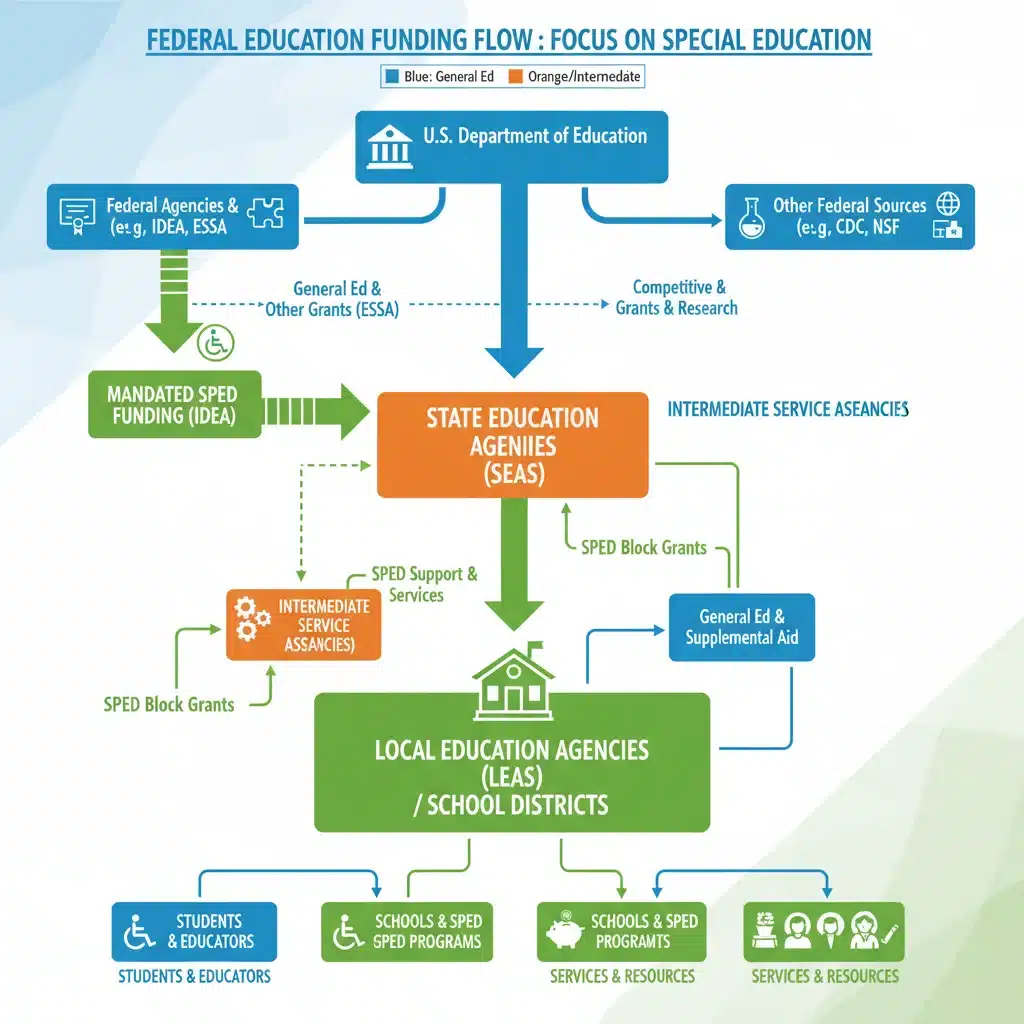
Understanding the mechanism of federal fund allocation is crucial for educators. IDEA Part B funds are distributed to states based on a formula that primarily considers the state’s child population aged 3-21 and the number of children with disabilities in that age range. States then sub-grant these funds to LEAs (school districts) based on similar enrollment data, with specific provisions for poverty factors.
However, it’s not a simple pass-through. States must meet certain requirements to receive and distribute these funds, including developing a state plan that outlines how they will comply with IDEA, ensuring proper oversight, and providing technical assistance to LEAs. School districts, in turn, must use these funds to supplement, not supplant, state and local special education expenditures. This ‘maintenance of effort’ provision is a cornerstone of IDEA funding, ensuring that federal dollars add to, rather than replace, existing special education budgets.
For Special Education Funding 2026, districts must be meticulous in their accounting and reporting to demonstrate compliance with these complex regulations. Mismanagement or non-compliance can lead to significant financial penalties and a loss of federal funds, directly impacting the services available to students with disabilities.

Strategic Planning for Optimal Resource Utilization
Given the persistent gap between federal funding commitments and actual appropriations, strategic planning is paramount for making the most of Special Education Funding 2026. Educators and administrators should consider the following strategies:
1. Comprehensive Needs Assessment
Before allocating any funds, conduct a thorough needs assessment to identify the specific requirements of your special education population. This includes not only direct instructional needs but also related services (speech therapy, occupational therapy, psychological services), assistive technology, professional development for staff, and accessible transportation. A data-driven approach will ensure that funds are directed to areas of greatest impact.
2. Maximizing Allowable Expenditures
IDEA funds can be used for a wide range of services, as long as they are related to providing FAPE. This includes salaries for special education teachers and related service providers, instructional materials, equipment, professional development, and even some administrative costs directly tied to special education. Districts should ensure they are fully utilizing all allowable expenditures to support their programs.
3. Blending and Braiding Funds
Federal special education funds don’t operate in isolation. Explore opportunities to blend IDEA funds with other federal, state, and local funding sources. For example, Title I funds (designed to support students in high-poverty schools) can often be used to support students with disabilities who also qualify for Title I services. Similarly, funds from the Every Student Succeeds Act (ESSA) or even grants from private foundations can be ‘braided’ together to create a more robust funding stream for comprehensive special education programs. This requires careful planning and adherence to the rules of each funding source, but it can significantly amplify resources for Special Education Funding 2026.
4. Investing in Professional Development
A well-trained and highly skilled special education workforce is invaluable. Allocating a portion of federal funds to ongoing professional development for teachers, paraprofessionals, and administrators can lead to improved instructional practices, better student outcomes, and increased staff retention. This investment pays dividends by enhancing the quality of services without necessarily increasing the quantity of staff.
5. Leveraging Technology and Innovative Solutions
Technology can be a powerful equalizer for students with disabilities. Investing in assistive technology, accessible learning platforms, and specialized software can provide individualized support, enhance engagement, and improve learning outcomes. Explore innovative solutions that can deliver services more efficiently or effectively, such as tele-therapy for related services in rural areas.
6. Data-Driven Decision Making
Regularly collect and analyze data on student progress, service delivery, and program effectiveness. This data will not only help demonstrate compliance with federal mandates but also inform future funding decisions. By understanding what works best for your student population, you can make more strategic choices about how to allocate Special Education Funding 2026.
Advocacy and Collaboration: Strengthening the Special Education Ecosystem
Beyond internal planning, external advocacy and collaboration are vital for securing and optimizing Special Education Funding 2026. Educators have a powerful voice that, when united, can influence policy and funding decisions at all levels.
1. Engaging with Policy Makers
Reach out to your state and federal representatives. Share success stories, articulate the challenges faced by your district, and provide concrete examples of how increased or sustained federal funding impacts students. Personal stories and data-backed arguments can be highly persuasive.
2. Partnering with Parent and Advocacy Groups
Parents of children with disabilities are powerful advocates. Collaborate with parent-teacher associations, special education advisory committees, and national advocacy organizations. Their collective voice can significantly amplify calls for stronger federal support for special education.
3. Intra-District Collaboration
Foster strong collaboration between general education and special education departments. Inclusive practices, co-teaching models, and universal design for learning (UDL) can optimize resources and benefit all students. When general education teachers are equipped to support students with mild to moderate disabilities, special education resources can be more effectively targeted to those with more intensive needs.
4. Inter-District and Regional Partnerships
Explore opportunities for inter-district collaboration, especially for specialized services that might be cost-prohibitive for a single district. Sharing resources, personnel, or even purchasing consortiums for assistive technology can lead to significant efficiencies and expanded service offerings. These partnerships can be particularly beneficial for smaller or rural districts grappling with limited resources for Special Education Funding 2026.
5. Grant Writing and Philanthropy
While federal and state funds are the primary sources, don’t overlook the potential of grants from private foundations, corporations, and community organizations. Many philanthropic entities are dedicated to supporting educational initiatives, including special education. Developing strong grant-writing skills within your district can open up additional funding avenues.
Challenges and Opportunities in 2026
As we look ahead to Special Education Funding 2026, several challenges and opportunities stand out:
Challenges:
- Inflationary Pressures: The rising cost of services, salaries, and materials can quickly erode the purchasing power of existing funding levels.
- Personnel Shortages: A persistent shortage of qualified special education teachers and related service providers necessitates competitive salaries and robust recruitment efforts, often straining budgets.
- Complex Student Needs: The increasing complexity of student needs, including mental health challenges and intensive behavioral supports, requires specialized and often expensive interventions.
- Compliance Burden: The extensive regulatory framework of IDEA requires significant administrative resources for reporting, documentation, and oversight.
Opportunities:
- Technological Advancements: New assistive technologies and online learning tools offer innovative ways to deliver instruction and support, potentially increasing efficiency and access.
- Increased Awareness and Advocacy: Growing public awareness of neurodiversity and the importance of inclusive education can lead to stronger political will for increased funding.
- Evidence-Based Practices: A greater emphasis on research-backed interventions can ensure that funds are spent on programs with proven effectiveness, leading to better outcomes and more efficient resource use.
- Collaborative Models: The development of integrated service delivery models that blend special education with general education and community resources can create more holistic and cost-effective support systems.
Navigating these challenges while seizing opportunities will be key to successful management of Special Education Funding 2026.
Preparing Your District for 2026: Actionable Steps
To ensure your district is well-prepared for any shifts in Special Education Funding 2026, consider implementing the following actionable steps:
- Form a Cross-Functional Team: Assemble a team comprising special education directors, finance officers, curriculum specialists, and possibly a school board member to monitor funding developments and strategize.
- Review Current Spending: Conduct a comprehensive audit of current special education expenditures to identify areas of efficiency, potential waste, or under-resourced needs.
- Stay Informed on Legislation: Subscribe to newsletters from national education organizations (e.g., Council for Exceptional Children, National Association of State Directors of Special Education) and legislative trackers to receive real-time updates on federal policy and appropriations.
- Develop a Robust Data Collection System: Ensure your district has a reliable system for collecting data on student demographics, service delivery, outcomes, and financial expenditures. This data is critical for compliance, advocacy, and informed decision-making.
- Invest in Grant Writing Training: Provide professional development for staff on identifying and writing competitive grants to secure additional funding sources.
- Cultivate Community Partnerships: Build relationships with local businesses, non-profits, and community organizations that may offer resources, volunteers, or in-kind services to support students with disabilities.
- Plan for Contingencies: Develop contingency plans for various funding scenarios, including potential cuts or unexpected increases. Flexibility in budgeting is a significant asset.
- Educate Stakeholders: Regularly communicate with school board members, parents, and the wider community about the importance of special education funding and the impact of federal policies.
Conclusion: A Proactive Stance for Student Success
The landscape of Special Education Funding 2026 demands a proactive, informed, and strategic approach from US educators. While federal funding has historically been insufficient to fully cover the costs mandated by IDEA, it remains a vital component of the overall special education budget. By understanding the policy frameworks, monitoring legislative developments, and implementing sound financial management strategies, districts can maximize the impact of every federal dollar.
Ultimately, the goal is to ensure that every student with a disability receives the free appropriate public education they are entitled to, enabling them to achieve their full potential. Educators are at the forefront of this mission, and their ability to navigate the complexities of federal funding will be instrumental in shaping the future of special education in the United States. By staying vigilant, advocating passionately, and planning strategically, we can collectively work towards a future where all students with disabilities have access to the resources and support they need to succeed.
Author