For the brave men and women who have served our nation, understanding the intricacies of Veteran Disability Compensation is paramount. As we look towards 2026, changes and updates are inevitable, making it crucial for veterans and their families to stay informed about the latest payout rates, eligibility criteria, and the application process. This comprehensive guide aims to demystify Veteran Disability Compensation, providing you with the knowledge needed to navigate the system effectively and secure the benefits you rightfully deserve.
The Department of Veterans Affairs (VA) provides disability compensation to veterans who have service-connected disabilities. These disabilities can be physical or mental conditions that were incurred or aggravated during active military service. The amount of compensation a veteran receives depends on the severity of their disability, which is assigned a disability rating, and their dependency status.
Understanding Veteran Disability Compensation: The Basics
Veteran Disability Compensation is a tax-free monetary benefit paid to veterans with disabilities that are the result of a disease or injury incurred or aggravated during active military service. It’s designed to compensate veterans for the average impairment in earning capacity resulting from their service-connected conditions. The VA assigns a disability rating from 0% to 100% in increments of 10%, with higher percentages indicating more severe disabilities and, consequently, higher compensation.
What Qualifies as a Service-Connected Disability?
To be eligible for Veteran Disability Compensation, your disability must be service-connected. This means there must be a direct link between your military service and your current medical condition. There are several ways a disability can be considered service-connected:
- Direct Service Connection: The disability resulted directly from an event, injury, or disease during your active military service.
- Presumptive Service Connection: Certain conditions are presumed to be service-connected if you served in a specific location or during a particular time period. Examples include Agent Orange exposure, Gulf War illnesses, and conditions related to burn pit exposure.
- Secondary Service Connection: A disability that developed as a result of an existing service-connected condition. For example, knee pain from an altered gait due to a service-connected back injury.
- Aggravation: A pre-existing condition that was worsened beyond its natural progression by your military service.
- Injuries from VA Medical Treatment: Disabilities that result from VA medical care for a service-connected condition.
Proving service connection often requires medical evidence, service records, and sometimes lay statements from individuals who witnessed the event or can attest to the onset of your symptoms during or after service.
Eligibility Criteria for 2026 Veteran Disability Compensation
While the core principles of eligibility for Veteran Disability Compensation remain consistent, it’s always wise to review any potential updates or clarifications for 2026. Generally, to be eligible, you must meet the following criteria:
- Served in the U.S. Military: You must have served on active duty, active duty for training, or inactive duty for training.
- Discharged Under Other Than Dishonorable Conditions: Your discharge must not have been dishonorable.
- Have a Service-Connected Disability: Your disability must be linked to your military service, as explained above.
Even if you believe your discharge was dishonorable, there may be avenues to appeal or have your discharge status reviewed, which could open the door to VA benefits. It’s crucial not to self-disqualify and to seek advice from a veterans service organization (VSO) or a VA accredited representative.
Special Considerations for Eligibility
Beyond the basic criteria, certain circumstances can influence your eligibility or the type of benefits you receive:
- Combat Veterans: Veterans injured in combat may have streamlined processes for certain claims.
- Prisoners of War (POWs): Former POWs have specific presumptive conditions that make it easier to establish service connection.
- Veterans Exposed to Toxic Substances: Recent legislation, such as the PACT Act, has expanded presumptive conditions for veterans exposed to burn pits, Agent Orange, and other toxic substances. Staying informed about these legislative changes is vital for 2026.
- Survivors’ Benefits: If a veteran passes away due to a service-connected disability, their surviving spouse, dependent children, or dependent parents may be eligible for Dependency and Indemnity Compensation (DIC).
Staying updated on legislative changes, particularly those that expand presumptive conditions or modify eligibility, is a key aspect of maximizing your Veteran Disability Compensation in 2026.
2026 Payout Rates for Veteran Disability Compensation: What to Expect
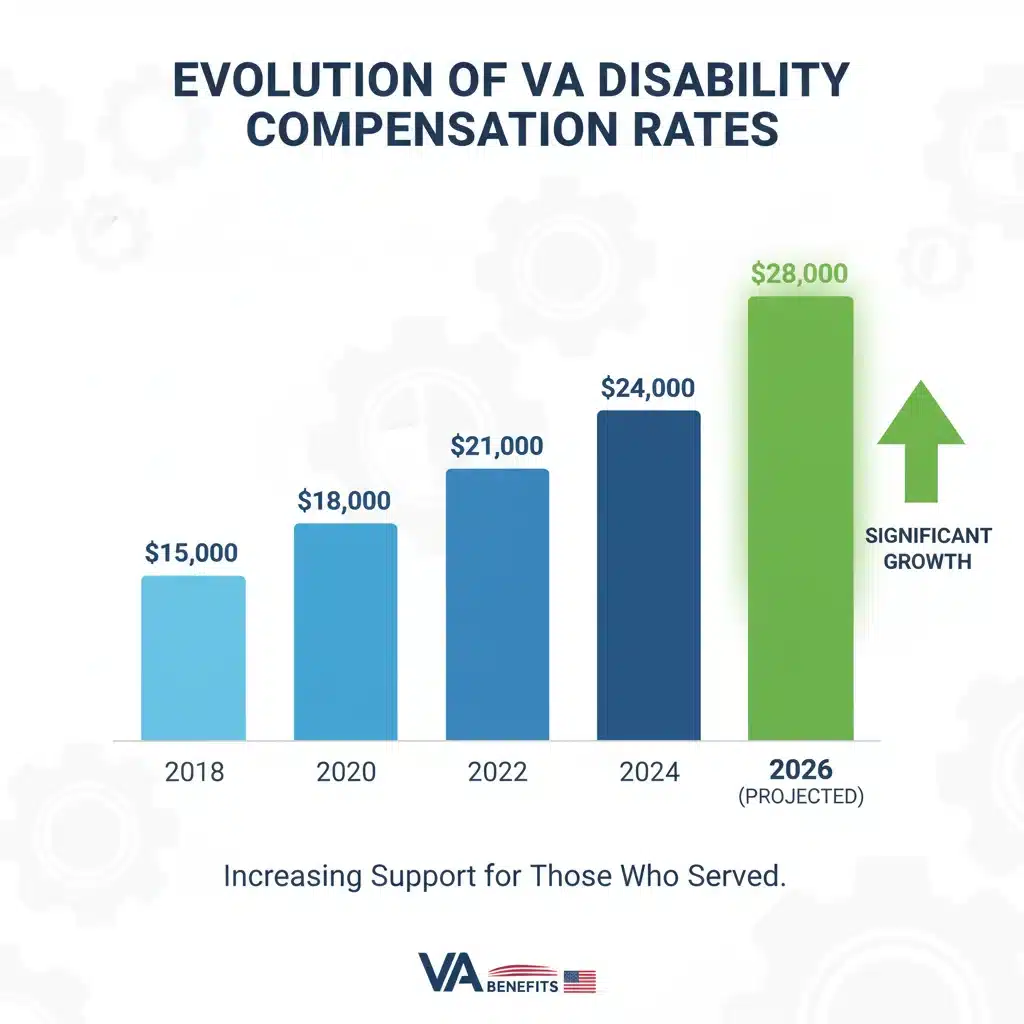
The VA disability compensation rates are typically adjusted annually based on the Cost-of-Living Adjustment (COLA) determined by the Social Security Administration. While the exact 2026 COLA has not yet been announced, historical trends suggest an increase to help veterans keep pace with inflation. The basic monthly compensation rate varies significantly based on your disability rating and the number of dependents you have.
Basic Monthly Rates (Example based on projections for 2026, actual rates may vary)
Below is a simplified projection of what basic monthly rates for a veteran with no dependents might look like in 2026. These are illustrative and should not be taken as definitive until official VA announcements.
- 10% Disability: Approximately $170 – $180
- 20% Disability: Approximately $330 – $350
- 30% Disability: Approximately $500 – $520
- 40% Disability: Approximately $720 – $740
- 50% Disability: Approximately $1,020 – $1,050
- 60% Disability: Approximately $1,290 – $1,320
- 70% Disability: Approximately $1,630 – $1,670
- 80% Disability: Approximately $1,890 – $1,930
- 90% Disability: Approximately $2,120 – $2,170
- 100% Disability: Approximately $3,700 – $3,800
These rates increase significantly if you have dependents (spouse, children, dependent parents). For example, a veteran with a 30% or higher disability rating and a spouse will receive a higher monthly payment. The VA provides detailed tables on their official website that account for various dependency scenarios. It is crucial to consult the official VA website or a VSO for the most accurate and up-to-date 2026 payout rates for Veteran Disability Compensation once they are released.
Special Monthly Compensation (SMC)
Beyond the basic rates, some veterans may be eligible for Special Monthly Compensation (SMC). SMC is an additional tax-free benefit paid to veterans, their spouses, surviving spouses, and parents with certain severe disabilities or combinations of disabilities. These can include the loss of a limb, blindness, or being housebound. SMC rates are significantly higher than the standard rates and are categorized by letters (e.g., SMC-K, SMC-L, SMC-R2, etc.), each with specific criteria.
The Application Process for Veteran Disability Compensation
Applying for Veteran Disability Compensation can seem daunting, but breaking it down into manageable steps can help. The process typically involves gathering evidence, submitting a claim, and attending a compensation and pension (C&P) exam.
Step 1: Gather Your Evidence
Before you even begin your application, thorough preparation is key. You’ll need to gather all relevant documents to support your claim. This includes:
- Service Medical Records: These are crucial for demonstrating that your injury or illness occurred or was aggravated during service.
- Private Medical Records: Any records from civilian doctors or hospitals related to your disability.
- Lay Statements: Statements from friends, family, or fellow service members who can attest to your symptoms or the event that caused your disability.
- Discharge Papers (DD214): Essential for verifying your service and discharge status.
- Marriage Certificates and Birth Certificates: If you plan to claim dependents.
The more comprehensive your evidence, the stronger your claim for Veteran Disability Compensation will be.
Step 2: File Your Claim
You can file your claim in several ways:
- Online: Through the VA’s eBenefits portal or VA.gov. This is often the quickest and most efficient method.
- With a VSO: A Veterans Service Organization (VSO) can help you prepare and submit your claim, often providing invaluable assistance and expertise.
- By Mail: You can download and mail the VA Form 21-526EZ, “Application for Disability Compensation and Related Compensation Benefits.”
- In Person: At a VA regional office.
It’s highly recommended to file an “Intent to File” form first. This locks in your effective date for benefits, meaning if your claim is approved, you’ll receive retroactive payments back to the date you filed your Intent to File, as long as you submit your complete application within one year.

Step 3: The Compensation & Pension (C&P) Exam
After you file your claim, the VA will likely schedule you for one or more Compensation and Pension (C&P) exams. These exams are conducted by VA-contracted doctors or VA medical professionals to assess the severity of your claimed disabilities and to determine if there is a nexus (link) between your service and your condition. It is vital to attend all scheduled C&P exams and be honest and thorough in describing your symptoms and how they impact your daily life.
Step 4: Decision and Appeals
Once the VA has gathered all necessary information, they will issue a decision on your claim. If your claim for Veteran Disability Compensation is denied or you disagree with the disability rating assigned, you have the right to appeal. The VA offers several appeal options, including a Supplemental Claim, a Higher-Level Review, or an appeal to the Board of Veterans’ Appeals. Navigating the appeals process can be complex, and seeking assistance from a VSO or a veterans’ law attorney is highly advisable.
Maximizing Your Veteran Disability Compensation in 2026
Beyond simply filing a claim, there are several strategies veterans can employ to maximize their Veteran Disability Compensation.
Regular Medical Documentation
Consistent medical documentation of your conditions, even after your initial claim is approved, is crucial. If your service-connected disability worsens, you can file a claim for an increased rating. Without current medical evidence detailing the progression of your condition, it’s difficult for the VA to grant an increase.
Understanding Secondary Conditions
Many veterans overlook secondary conditions. For example, if you have a service-connected knee injury that causes you to walk with a limp, and this limp leads to hip or back pain, the hip or back pain could be claimed as a secondary service-connected condition. Always consider how your primary service-connected disabilities might be impacting other areas of your health.
Total Disability Individual Unemployability (TDIU)
If your service-connected disabilities prevent you from maintaining substantially gainful employment, even if your combined disability rating is less than 100%, you might be eligible for Total Disability Individual Unemployability (TDIU). TDIU pays veterans at the 100% disability rate, even if their combined scheduler rating is lower. To qualify, you generally need at least one service-connected disability rated at 60% or more, or two or more service-connected disabilities with at least one rated at 40% or more and a combined rating of 70% or more, and be unable to maintain substantially gainful employment due to your service-connected conditions.
Dependency Claims
Ensure all eligible dependents (spouse, minor children, adult children enrolled in school, or dependent parents) are properly listed on your VA records. Adding dependents can increase your monthly Veteran Disability Compensation, especially if your disability rating is 30% or higher.
Stay Informed on Legislative Changes
As mentioned earlier, legislative changes like the PACT Act can significantly impact eligibility and benefits. Regularly check the VA’s official website or subscribe to updates from reputable veterans’ organizations to stay abreast of any new laws or policies that could affect your Veteran Disability Compensation.
Common Pitfalls to Avoid
Navigating the VA system can be complex, and certain missteps can delay or even jeopardize your claim. Here are some common pitfalls to avoid:
- Incomplete Applications: Submitting a claim without all the necessary evidence or forms can lead to delays or denials.
- Missing C&P Exams: Failing to attend scheduled Compensation and Pension exams can result in your claim being denied.
- Lack of Medical Evidence: Without a clear diagnosis and medical records linking your condition to service, your claim will be difficult to prove.
- Not Appealing Denials: Many veterans get discouraged by an initial denial. However, the appeals process is there for a reason, and many claims are eventually approved on appeal.
- Not Seeking Professional Help: Attempting to navigate the complex VA system alone can be overwhelming. VSOs and accredited representatives are invaluable resources.
The Role of Veterans Service Organizations (VSOs)
Veterans Service Organizations (VSOs) play a critical role in assisting veterans with their claims for Veteran Disability Compensation. Organizations like the American Legion, Disabled American Veterans (DAV), Veterans of Foreign Wars (VFW), and many others provide free assistance, including:
- Claim Preparation: Helping veterans gather evidence and complete application forms.
- Representation: Acting as an accredited representative to communicate with the VA on your behalf.
- Appeals Assistance: Guiding veterans through the often-complex appeals process.
- Information and Advocacy: Keeping veterans informed about changes in VA law and advocating for veterans’ rights.
Utilizing the expertise of a VSO can significantly increase your chances of a successful claim and ensure you receive all the benefits you are entitled to.
Future Outlook for Veteran Disability Compensation in 2026 and Beyond
The landscape of Veteran Disability Compensation is continually evolving. With ongoing legislative efforts to address veteran health concerns, such as toxic exposures and mental health, it’s reasonable to anticipate further expansions of benefits and presumptive conditions. The VA is also continuously working to streamline its claims process and make it more accessible to veterans.
For 2026, while the core structure of disability compensation will remain, veterans should keep an eye on official VA announcements regarding COLA increases, any new presumptive conditions, and potential changes to the application or appeals process. Digital tools and online resources provided by the VA are also expected to become even more robust, offering veterans greater ease in managing their benefits.
Conclusion
Securing Veteran Disability Compensation is a fundamental right for those who have sacrificed for our country. Understanding the eligibility requirements, the application process, and the potential payout rates for 2026 is crucial for all veterans. By being proactive, gathering comprehensive evidence, and utilizing the resources available through the VA and VSOs, you can navigate the system with confidence and ensure you receive the support you deserve.
Remember, your service and sacrifices are deeply appreciated, and the benefits you receive are a testament to our nation’s commitment to its veterans. Stay informed, stay persistent, and don’t hesitate to seek expert guidance to maximize your Veteran Disability Compensation.